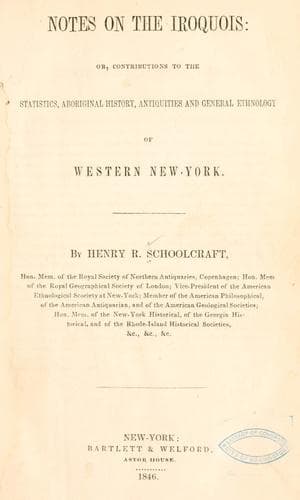
Notes on the Iroquois: or, Contributions to the Statistics, Aboriginal History, Antiquities and General Ethnology of Western New-YorkSchoolcraft, Henry Rowe
History
Notes on the Iroquois: or, Contributions to the Statistics, Aboriginal History, Antiquities and General Ethnology of Western New-York
Schoolcraft, Henry Rowe
Indians of North America -- New York (State); Iroquois Indians
[50] This remark is not made to depreciate the literary merits of the
esteemed and lamented author of the Life of Brant, but as being simply
due to the cause of truth. Few men have better earned the respect and
remembrance of the public than William L. Stone, whose whole life was
an example of what energy and talents can achieve. It was not, indeed,
to be expected that the incessant duties of the diurnal press should
permit historical scrutiny into a matter, very obscure in itself, and
of which the details are only to be gleaned after laborious search at
remote points.
What was true of the totemic organization of the Senecas, was equally
so of the Mohawks, and of each of the other cantons. Each canton
consisted, like the Senecas, of the clans of the wolf, bear, turtle,
beaver, deer, falcon, plover and crane. But each of these clans were
increments of re-organizations of one of the eight original clans.
They were brothers, and appealed to their respective totems as a proof
of original consanguinity. They were entitled to the same rites of
hospitality, in the lodges of their affiliated totems abroad, that
they were entitled to at home. The affiliated mark on the lodge was
a sufficient welcome of entrance and temporary abode. It results,
therefore, that there were but eight original family clans, estimating
at the maximum number existing in six cantonal departments, or tribes,
and that the entire six tribes were bound together politically by these
eight family ties. As a matter of course, each clan was not equally
numerous in each tribe. This would depend on accidental circumstances
and natural laws; but it is an argument in favor of the antiquity of
the people, or the confederacy, that each of the tribes had organized
in each of the respective clans. For we cannot suppose that at first
there was a systematic, far less, an equal division of the clans,
or that their original separation into separate tribes, or cantons,
was the result of a considerate formal public act. This would be to
reverse the ordinary progress of tribes and nations who, in early ages,
separate from circumstances and causes wholly casual, such as the
ambition or feuds of chiefs, the desire of finding better places to
live, easier means of subsistence, &c.
In the condition of a people, living in a government so purely
patriarchal, following game for a subsistence, and making wars to
enlarge or defend their hunting grounds, the oldest and most respected
man of his clan or totem, would necessarily be its sachem or political
head. We must assume that to be a fixed and settled principle of their
simple constitution and verbal laws, which appears, from all we know,
to have been so. Letters, they had none, and their traditions on this
head are to be gleaned from scattered and broken sources which do not
always coincide.
Public-domain text, read in full here on John Shaqi.
Reviews
Reviews
No reviews yet
Be the first to share your thoughts on this work.
Elsewhere in the archive
Join the Discussion
Join the discussion
Sign in to leave a comment or review.
Sign InorCreate an account