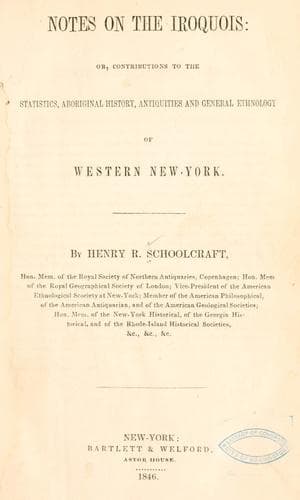
Notes on the Iroquois: or, Contributions to the Statistics, Aboriginal History, Antiquities and General Ethnology of Western New-YorkSchoolcraft, Henry Rowe
History
Notes on the Iroquois: or, Contributions to the Statistics, Aboriginal History, Antiquities and General Ethnology of Western New-York
Schoolcraft, Henry Rowe
Indians of North America -- New York (State); Iroquois Indians
If each clan had its leading sachem or chief, there were eight
principal chiefs in each canton. Consequently, when the confederacy
consisted of five cantons, there were forty Rakowanas,[51] or head
chiefs. These were the recognized leaders and magistrates in the
villages; but in effect, in a community thus constituted, each Rakowana
or ruling chief of a clan, has a number of aids, Mishinawas[52] and
minor officials, who were also regarded as semi-sachems, or chiefs.
This number is always indefinite and fluctuating, but may be supposed
to be, in relation to the ruling Rakowana, as at least five to one.
[51] Mohawk.
[52] Algonquin.
This would give to each canton forty inferior chiefs, and to the five
cantons, two hundred, denoting a distribution of power and civil
organization, which acting in union must have been very efficacious;
and the more so, when we consider that all their political movements
were entirely of a popular cast, and carried with them the voice of
every man in the canton.
This appears to have been the standing civil organization; but it was
entirely independent of the military system. War chiefs appear ever to
have derived their authority from courage and capacity in war, and to
have risen up as they were required in each canton. The Tekarahogea,
or war captain, founded his rights and powers in the Indian camp, on
former triumphs and present capacity; but the office does not appear
to have been a general one recognized by their constitution. All males
were bound to render military service by custom and opinion, but by
nothing else. Disgrace and cowardice were the penalties, but they were
penalties more binding than oaths or bonds among civilized communities,
and always kept their ranks full. All war parties were, of course,
volunteers. It seems that all able-bodied males over fourteen were
esteemed capable of taking the war path; the early development of
martial power being considered of all traits the most honorable. No
title was more honored than that of Roskeahragehte,[53] or Warrior.
[53] Mohawk.
There was no baggage to encumber the march of an Iroquois army.
The decision of Alexander and the policy of Bonaparte were alike
unnecessary here. Each Iroquois warrior supplied and carried his own
arms and provisions. He joined the war dance, the analogous term for
enlistment, for the particular expedition in hand. If it failed, or
another force was required, other captains called for other volunteers,
and sung their war songs to inflame the ardor of the young. Taunts
and irony of the deepest character were, on these occasions, flung at
the character of the enemy. The war chief lifted his tomahawk as if
actually engaged in combat, and in imagination he stamped his enemy
under foot, while he symbolically tore off his scalp, and uttered his
sharp Sasakwon,[54] or war whoop.
[54] Algonquin.
Public-domain text, read in full here on John Shaqi.
Reviews
Reviews
No reviews yet
Be the first to share your thoughts on this work.
Elsewhere in the archive
Join the Discussion
Join the discussion
Sign in to leave a comment or review.
Sign InorCreate an account