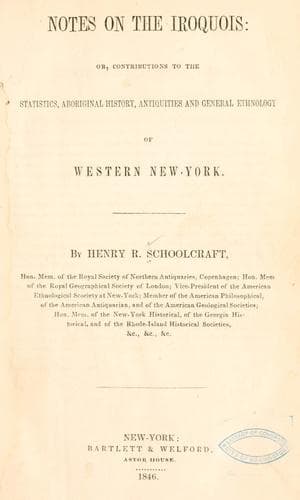
Notes on the Iroquois: or, Contributions to the Statistics, Aboriginal History, Antiquities and General Ethnology of Western New-YorkSchoolcraft, Henry Rowe
History
Notes on the Iroquois: or, Contributions to the Statistics, Aboriginal History, Antiquities and General Ethnology of Western New-York
Schoolcraft, Henry Rowe
Indians of North America -- New York (State); Iroquois Indians
With regard to the first era, it is almost wholly the subject of
general and profound scientific and philosophical investigations, which
require a union of great advantages for successful study. The second
and third eras, fall within the compass of ordinary observation. Both
kinds of proof may exist at the very same localities. They do not
necessarily imply diverse or remote geographical positions. We know
that some of the leading tribes, the Cherokees, (till within a few
years,) and the Iroquois, for instance, have continued to live in the
very same positions in which they were found by the first explorers.
As their chiefs and warriors died, they carried to their places of
burial, (such was the result of ancient and general custom,) those
kinds of ornaments, arms and utensils, which were the distinguishing
tokens of art, of the several eras in which they lived.
The coming of European races among them introduced fabrics of metal,
earths, enamels, glass, and other materials more or less durable, and
capable of resisting decomposition. These would necessarily take the
place of the aboriginal articles of stone and shell, before employed.
If, then, places of sepulture were permanent, the inquirer at the
present day would find the various fabrics of the second and the third
era, in the same cemeteries and burial grounds, and sometimes in the
same barrows and mounds.
Modes of defence would also alter by the introduction of the second
period. The simple ring-fort, with palisades, crowning a hill, which
would serve as a place of excellent defence, against bows and arrows
and clubs, would prove utterly useless, as the Tuscaroras found at
Naharuke in 1712, after the introduction of artillery. A trench to
obtain water, from a spring or creek, leading from one of the works
of the older period, might have been so covered as to afford full
protection from the simple aboriginal missiles. Besides this, the
combination of several tribes, as the Iroquois, the Algonquins,
the Eries, Alleghans and others, might render these simple forts,
defended with ditches, mounds, and otherwise, no longer necessary,
in the interior of their territory, after the time of such general
combinations or confederacies. And in this case, these works would be
deserted and become ruins, long before the period of the discovery.
Public-domain text, read in full here on John Shaqi.
Reviews
Reviews
No reviews yet
Be the first to share your thoughts on this work.
Elsewhere in the archive
Join the Discussion
Join the discussion
Sign in to leave a comment or review.
Sign InorCreate an account