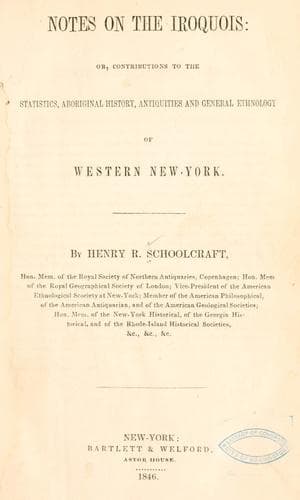
Notes on the Iroquois: or, Contributions to the Statistics, Aboriginal History, Antiquities and General Ethnology of Western New-YorkSchoolcraft, Henry Rowe
History
Notes on the Iroquois: or, Contributions to the Statistics, Aboriginal History, Antiquities and General Ethnology of Western New-York
Schoolcraft, Henry Rowe
Indians of North America -- New York (State); Iroquois Indians
Marriage, among the Iroquois, appears to be a verbal contract between
the parties, which does not affect the rights of property. Goods,
personal effects, or valuables of any kind, personal or real, which
were the wife’s before, remain so after marriage. Should any of these
be used by the husband, he is bound to restore the property or its
worth, in the event of separation. It is not uncommon at present to
find a husband indebted to a wife for moneys loaned of her, derived
from payments or property, which she owned, and still owns, in her own
right; and it is a cause of union in some cases where, without this
obligation, a separation would probably ensue.
Marriage is therefore a personal agreement, requiring neither civil nor
ecclesiastical sanction, but not a union of the rights of property.
Descent being counted by the female may be either an original cause or
effect of this unique law.
IV. ARCHÆOLOGY.
In considering the subject of American antiquities it may facilitate
the object, to erect separate eras of occupancy, to which the facts
may be referred. Such a division of the great and almost unknown
period, which preceded the arrival of Europeans, will at least serve
as convenient points to concentrate, arrange and compare the facts and
evidences brought forward; and may enable the observer, the better to
proceed in any future attempts to generalize.
There appear to have been three eras in the aboriginal occupancy of the
continent, or more strictly speaking, three conditions of occupancy,
which may be conveniently grouped as eras, although the precise limits
of them, may be matters of some uncertainty. To make this uncertainty
less than it now is, and to erect these eras on probable foundations,
the proofs drawn from monuments, mounds, fortifications, ditches,
earth-works, barrows, implements of art, and whatever other kind of
evidence antiquity affords, may, it is thought, be gathered together in
something like this shape, namely:
1. Vestiges and proofs of the original era of the aboriginal migration
from other parts of the globe. These, so far as arts or evidences of
a material character are denoted, must necessarily be exceedingly
limited, if any, of undoubted authenticity, shall indeed now be found.
The departments of physiology, and philology, which have heretofore
constituted the principal topics of research, are still an attractive,
and by no means a closed field.
2. Proofs and vestiges of their continental migrations, wars,
affinities and general ethnological characteristics, prior to the
discovery of the continent. Such are the grouping of languages; the
similarity, or dissimilarity of arts, modes of defence, and means of
subsistence.
3. Proofs and vestiges of occupancy, change, and progress, subsequent
to the Columbian period.
Public-domain text, read in full here on John Shaqi.
Reviews
Reviews
No reviews yet
Be the first to share your thoughts on this work.
Elsewhere in the archive
Join the Discussion
Join the discussion
Sign in to leave a comment or review.
Sign InorCreate an account