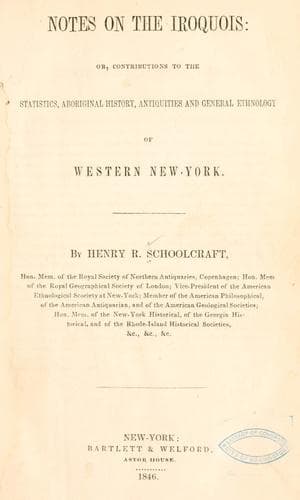
Notes on the Iroquois: or, Contributions to the Statistics, Aboriginal History, Antiquities and General Ethnology of Western New-YorkSchoolcraft, Henry Rowe
History
Notes on the Iroquois: or, Contributions to the Statistics, Aboriginal History, Antiquities and General Ethnology of Western New-York
Schoolcraft, Henry Rowe
Indians of North America -- New York (State); Iroquois Indians
A. indicates the lines of a picketed work. B. is an extensive plain,
covered with wild grass and some shrubbery, which had once been in
cultivation. The northern edge of this plain is traversed by a stream,
which has worn its bed down in the unconsolidated strata, so as to
create quite a deep gorge, C. This stream is joined from the west, by a
small run, having its origin in a spring, D. Its channel, at the point
of junction, is as deep below the level of the plain as the other.[57]
The point of junction itself forms a natural hornwork, which covered
access to the water. The angle of the plain, thus marked, constituted
the point defended. The excavations E. may have once been square.
They are now indentations, disclosing carbonaceous matter, as if from
the decay of wood. No wood, or coal, however, existed. Their use in
this position is not apparent, connected with the designated lines of
palisades, unless it be supposed that they were of an older period than
the latter, and designate pits, such as the aborigines used in defence.
This idea is favored by the ground being a little raised at this
point, and so formed that it would have admitted the ancient circular
Indian palisade. If such were the case, however, it seems evident that
the spot had been selected by the French, at an early period, when,
as is known, they attempted to obtain a footing in the country of
the Oneidas. The distance is less than ten miles northwest of Oneida
Castle. It probably covered a mission. The site, which my informant,
living near, called the OLD FRENCH FIELD, may be supposed to
have been cultivated by servants or traders connected with it.
[57] Some few miles below this stream is the site of an iron cupola or
blast furnace, where the red or lenticular oxyd is reduced.
The oak and maple trees, which once covered it, as denoted by the
existing forest, F. F., are such, in size and number, as to have
required expert axmen to fell.
With the exception of two points, in the Oneida Creek valley, where
there are still vestiges of French occupation, supported by tradition,
this work is the most easterly of those known, which remain to testify
the adventurous spirit, zeal and perseverance which marked the attempt
of the French crown to plant the flag and the cross in western New-York.
The bold nature of this scheme to colonize the country, and bring
the Iroquois to acknowledge their dependence upon France, and the
importance of the experiment and the issue, cannot be well conceived
without reference to the history of those times. Pending the famous
expedition of the Chevalier de Vandreiul, 1696, into the Iroquois
country, it is known that the Jesuit Milet was stationed among the
Oneidas, over whom he had so much influence, that soon after the
termination of this vain display of power, thirty Oneidas deserted to
the French, and desired that Milet might be appointed their pastor.[58]
[58] Colden’s Five Nations, p. 193.
Public-domain text, read in full here on John Shaqi.
Reviews
Reviews
No reviews yet
Be the first to share your thoughts on this work.
Elsewhere in the archive
Join the Discussion
Join the discussion
Sign in to leave a comment or review.
Sign InorCreate an account