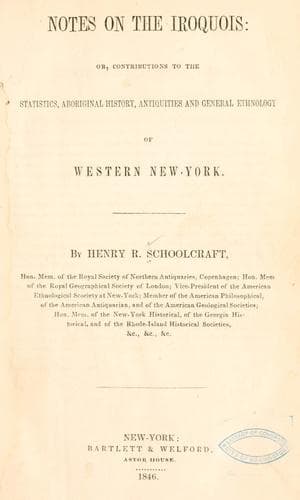
Notes on the Iroquois: or, Contributions to the Statistics, Aboriginal History, Antiquities and General Ethnology of Western New-YorkSchoolcraft, Henry Rowe
History
Notes on the Iroquois: or, Contributions to the Statistics, Aboriginal History, Antiquities and General Ethnology of Western New-York
Schoolcraft, Henry Rowe
Indians of North America -- New York (State); Iroquois Indians
[_b._] Ancient site of the Onondagas in the valley of the Kasonda, or
Butternut creek of Jamesville.
The fact that the ruins of a square fort, with extensive sub-lines
in the nature of an enclosure, had existed on the elevated grounds
on the right banks of this stream, a mile or two from Jamesville, at
the period of its first settlement, led me to visit it. There was the
more interest imparted to this well attested tradition of the present
inhabitants, by the accounts of the Onondagas, that this valley, in its
extent above and below Jamesville, was one of their earliest points
of settlement, prior to the era of their establishing their council
fire at Onondaga Hollow. The subjoined sketch, although not plotted
from actual measurement, will convey an idea of the relative position
and former importance of the principal features, geographical and
artificial, denoted.
[Illustration]
A. indicates the site of the fort, which, at the time of my visit, was
covered with a luxuriant field of wheat, without a feature to denote
that it had ever been held under any other jurisdiction but that of
the plough. The farm which embraces it, is owned and occupied by Isaac
Keeler, who remarks that, at the time he came to settle here, the site
of the old fort was an extensive opening in the forest, bearing grass,
with some clumps of wild plumb trees, and a few forest trees. On this
opening, the first regiment of militia that ever paraded in Onondaga
county, met. It was commanded by MAJOR DE WITT, after whom the
township is now named.
About the year 1810, he felled an oak, near the site of the fort,
measuring two feet six inches in diameter. In recutting it for fire
wood, after it had been drawn to his door, a leaden bullet was found,
covered by one hundred and forty-three cortical layers. From its
position, embedded as it was in the compact wood, it was still some
distance to the heart of the tree. He thinks this tree may have been a
sapling when the bullet was fired. Whether this conjecture be true or
not, one hundred and forty-three years appear to have elapsed since the
bullet assumed its position. This would give A. D. 1667 as the era.
In 1666, the Governor of Canada concluded a treaty with the Onondaga
Iroquois, as is seen from the “Paris Documents” obtained by Mr.
Broadhead. Colden’s history of the Five Nations, which has been the
principal source of information heretofore, after a brief summary
of traditionary matter,[59] in the first chapter, opens with the
transactions in 1665. This matter is more fully and satisfactorily
stated by Charlevoix in his history of New France, from whom it is
presumable, Colden drew his information of the former power and
pre-eminence of the Adirondacks.
[59] The States General of Holland surrendered New-York to the English
crown in 1664.
Public-domain text, read in full here on John Shaqi.
Reviews
Reviews
No reviews yet
Be the first to share your thoughts on this work.
Elsewhere in the archive
Join the Discussion
Join the discussion
Sign in to leave a comment or review.
Sign InorCreate an account