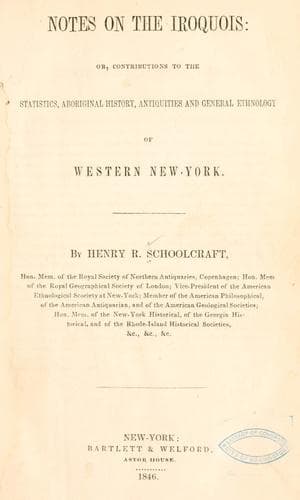
Notes on the Iroquois: or, Contributions to the Statistics, Aboriginal History, Antiquities and General Ethnology of Western New-YorkSchoolcraft, Henry Rowe
History
Notes on the Iroquois: or, Contributions to the Statistics, Aboriginal History, Antiquities and General Ethnology of Western New-York
Schoolcraft, Henry Rowe
Indians of North America -- New York (State); Iroquois Indians
E. represents the Twin Mounds, two natural formations of fine gravel
and other diluvial strata, situated on the south side of the creek, on
the farm of Jeremiah Gould. These mounds are conspicuous features in
the landscape, from their regularity, and position on elevated grounds,
as well as from their connection with the ancient Indian history of
the valley. These pyramidal heaps of earth are connected, by a neck of
earth, in the manner represented. They exhibit the appearance of having
been cleared of the forest, almost entirely, at an ancient date. The
surface exhibits numerous pits or holes, which excite the idea of their
having served as a noted locality for the Indian Assenjigun, or pit for
hiding or putting _en cache_, corn or other articles, to preserve it
from enemies, or as a place of deposit during temporary absences from
the village. There can, I think, be little question that this was the
true use and relation these geological eminences bore to the ancient
town on the Kasonda, marked B. Such, too, is the general impression
derived from local tradition. Some years ago, a skeleton was exhumed
from one of these _caches_.
[_c._] Antiquities of Pompey and adjacent parts of Onondaga county.
No part of western New-York has furnished a larger number of
antiquarian remains, or been more often referred to, than the
geographical area which constituted the original town of Pompey. There
is, consequently, the less need of devoting elaborate attention to
the details of this particular locality. It was first visited and
described by De Witt Clinton, in 1810-11,[61] and the plough has since
rendered it a task less easy than it then was, to examine the lines of
its ancient works and its archæological remains. It is quite evident,
from the objects of art disclosed at and about these antique sites of
security and defence, that civilized man dwelt here in remote times,
and there must be assigned to this part of the State a period of
European occupancy prior to the commonly received historical era of
discovery and settlement, or, at least, if falling within it, as there
is now reason to believe, yet almost wholly unknown, or forgotten in
its annals. Sismondi has well remarked, that only the most important
events come down to posterity, and that fame, for a long flight,
prepares to forget every thing which she possibly can. That no accounts
should remain of obscure events, in a remote part of the country, at
an early date, is not surprising. As it is, we must infer both the
dates and the people, from such antiquarian remains of works of art and
historical comparisons as can be obtained.
[61] Trans. of Philo. and Lit. Society of New-York.
Public-domain text, read in full here on John Shaqi.
Reviews
Reviews
No reviews yet
Be the first to share your thoughts on this work.
Elsewhere in the archive
Join the Discussion
Join the discussion
Sign in to leave a comment or review.
Sign InorCreate an account