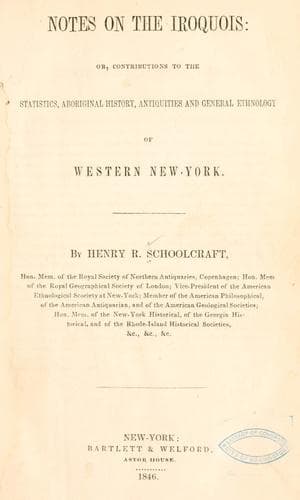
Notes on the Iroquois: or, Contributions to the Statistics, Aboriginal History, Antiquities and General Ethnology of Western New-YorkSchoolcraft, Henry Rowe
History
Notes on the Iroquois: or, Contributions to the Statistics, Aboriginal History, Antiquities and General Ethnology of Western New-York
Schoolcraft, Henry Rowe
Indians of North America -- New York (State); Iroquois Indians
Number 1, represents an antique collar or medal, [Nabikoágun,] wrought
out of sea shell. It is crossed with two parallel, and two horizontal
lines, ornamented with dots, and dividing the surface into four equal
parts. An orifice exists for introducing a string to suspend it about
the neck. This species of article, is found in Indian graves of the
period preceding the discovery of the continent, or not extending more
than one or two generations into the new period. It was probably an
elegant ornament when bright and new, and exhibiting the natural color
and nacre of the shell. Inhumation has so far served to decompose
the surface, as to coat it with a limy or chalky exterior, which
effervesces in mineral acids. By scraping deep into it, the shelly
structure is detected. This kind of ornament, varying much in size,
was probably soon replaced by the metallic gorget and medal introduced
by the trade, and has long been unknown both to Indians and traders.
I found it first in Indian cemeteries of the west, without, however,
for some time suspecting its real nature, supposing it some variety of
altered pottery, or enamel paste; but have since traced it over the
entire area of the ancient occupation of western New-York, and, so far
as examined, of Canada.
No. 2. A stone ring, one inch and two-tenths in diameter, made
of a dark species of somewhat hard steatite or slaty rock. Its
characteristic trait is found in its adaptation to the middle finger,
(of a male) and its having eleven distinct radiating lines.
No. 3. A globular bead or amulet, [Minace,] of sea shell one inch and a
half in diameter, solid and massy, having an orifice for suspending it.
It is slightly ovate. Its structure from shell, is distinctly marked.
Like the flat medal-shaped Nabikoágun (No. 1.) of the same material,
it has a limy coating from the effects of partial decomposition. In
the remaining features of the sketch, referred to, letters G. G.,
denote ancient remains of a European character in the contiguous part
of the town of Pompey, which are more particularly described in the
documentary appendix.
Public-domain text, read in full here on John Shaqi.
Reviews
Reviews
No reviews yet
Be the first to share your thoughts on this work.
Elsewhere in the archive
Join the Discussion
Join the discussion
Sign in to leave a comment or review.
Sign InorCreate an account