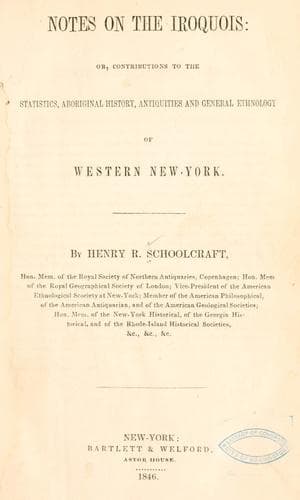
Notes on the Iroquois: or, Contributions to the Statistics, Aboriginal History, Antiquities and General Ethnology of Western New-YorkSchoolcraft, Henry Rowe
History
Notes on the Iroquois: or, Contributions to the Statistics, Aboriginal History, Antiquities and General Ethnology of Western New-York
Schoolcraft, Henry Rowe
Indians of North America -- New York (State); Iroquois Indians
In examining the archæology of this part of New-York, we are,
therefore, to look for decisive proofs of the early existence of this
trade in the hands of the two powers named. The Dutch were an eminently
commercial people, at the epoch in question, and pursued the fur trade
to remote parts of the interior, at an early date. They had scarcely
any other object at the time but to make this trade profitable.
Settlements and cultivation was a business in the hands of patroons,
and was chiefly confined to the rich vallies and intervales of the
southern parts of the State. They were, at the same time, too sagacious
to let any thing interrupt their good understanding with the natives;
and on this account, probably, had less need of military defences
of a formidable kind than the French, who were a foreign power. It
was, besides, the policy of New-France,—a policy most perseveringly
pursued,—to wrest this trade, and the power of the Indians, from the
hands of the Dutch and their successors, the English. They sought
not only to obtain the trade, but they intrigued for the territory.
They also made the most strenuous endeavors to enlist the minds of
the Indians, by the ritual observances of the Romish church, and to
propagate among the Iroquois its peculiar doctrines. They united in
this early effort the sword, the cross, and the purse.
Were all the libraries of Europe and America burned and totally
destroyed, there would remain incontestible evidences of each of the
above named efforts, in the metallic implements, guns, sword-blades,
hatchets, locks, bells, horse-shoes, hammers, paste and glass beads,
medals, crucifixes and other remains, which are so frequently turned up
by the plough in the fertile wheat and cornfields of Onondaga.
Looking beyond this era, but still found in the same geographical area,
are the antiquities peculiar to the Ante-Columbian period, and the
age of intestine Indian wars. These are found in various parts of the
State, in the ancient ring forts, angular trenches, moats, barrows, or
lesser mounds, which constituted the ancient simple Indian system of
castrametation.
This era is not less strongly marked by the stone hatchets, pestles,
fleshing instruments, arrow-heads and javelins of chert and hornstone;
amulets of stone, bone and sea-shells, wrought and unwrought; needles
of bone, coarse pottery, pipes, and various other evidences of antique
Indian art. The practice of interring their favorite utensils,
ornaments and amulets with the dead, renders their ancient grave-yards,
barrows and mounds the principal repositories of these arts. They are,
in effect, so many museums of antiquity.
Public-domain text, read in full here on John Shaqi.
Reviews
Reviews
No reviews yet
Be the first to share your thoughts on this work.
Elsewhere in the archive
Join the Discussion
Join the discussion
Sign in to leave a comment or review.
Sign InorCreate an account