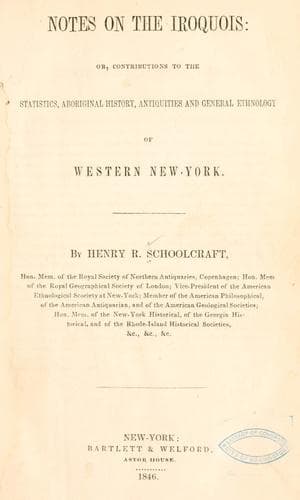
Notes on the Iroquois: or, Contributions to the Statistics, Aboriginal History, Antiquities and General Ethnology of Western New-YorkSchoolcraft, Henry Rowe
History
Notes on the Iroquois: or, Contributions to the Statistics, Aboriginal History, Antiquities and General Ethnology of Western New-York
Schoolcraft, Henry Rowe
Indians of North America -- New York (State); Iroquois Indians
In the preceding sketches, evidences have been presented of the
readiness and good judgment of the aboriginal fort builders of western
New-York,[67] in availing themselves of steeps, gulfs, defiles, and
other marked localities, in establishing works for security or defence.
This trait is, however, in no case more strikingly exemplified than in
the curious antique work before us, which is called, by the Tuscaroras,
KIENUKA. The term Kienuka is said to mean the stronghold or
fort, from which there is a sublime view. It is situated about three
and a half or four miles eastward of the outlet of the Niagara gorge at
Lewiston, on a natural escarpment of the ridge.
[67] It is not without something bordering on anachronism, that
this portion of the continent is called New-York, in reference to
transactions not only before the bestowal of the title, in 1664,
but long before the European race set foot on the continent. Still
more inappropriate, however, was the term of New-Netherland, i. e.
New-Lowland, which it bore from 1609 to 1664, many parts of the State
being characterized by lofty mountains, and all having an elevation
of many hundreds of feet above the sea. In speaking of these ancient
periods, a title drawn from the native vocabulary would better accord
with the period under discussion, if not with the laws of euphony. But
the native tribes were poor generalizers, and omitted to give generic
names to the land. The term of Haonao for the continent, or “island,”
as they call it, occurs, but this would have no more pertinence
applied to New-York, than to any other portion of it. The geographical
feature most characteristic of the State, is NIAGARA, and
next in prominence, ONTARIO, and either would have furnished
a better cognomen for the State, had they been thought of in season.
But it is too late now to make the change, and even for the remote era
alluded to, the name under which the country has grown great, is to be
preferred. It is already the talismanic word for every honorable and
social reminiscence.
Public-domain text, read in full here on John Shaqi.
Reviews
Reviews
No reviews yet
Be the first to share your thoughts on this work.
Elsewhere in the archive
Join the Discussion
Join the discussion
Sign in to leave a comment or review.
Sign InorCreate an account