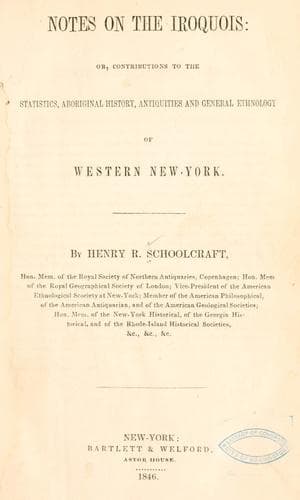
Notes on the Iroquois: or, Contributions to the Statistics, Aboriginal History, Antiquities and General Ethnology of Western New-YorkSchoolcraft, Henry Rowe
History
Notes on the Iroquois: or, Contributions to the Statistics, Aboriginal History, Antiquities and General Ethnology of Western New-York
Schoolcraft, Henry Rowe
Indians of North America -- New York (State); Iroquois Indians
“5. It cannot have been designed merely to catch wild animals to be
driven into it from the south. The oblique line down to the spring is
opposed to this supposition, as well as the insufficiency of such a
trench to confine the animals of the forest.
“6. The same reasons render it improbable that the quadrangle was
designed to confine and protect domestic animals.
“7. It was probably a sort of fortified place. There might have been a
defence on the south side by a _stockade_, or some similar means, which
might have entirely disappeared.
“By what people was this work done?
“The articles found in the burying-ground at F, offer no certain reply.
The axes, chisels, &c. found on the Indian grounds in this part of the
State, were evidently made of the greenstone or trap, of New-England,
like those found on the Connecticut river in Massachusetts. The pipe
of limestone might be from that part of the country. The pipes seem to
belong to different eras.
“1. The limestone pipe indicates the work of the savage or aborigines.
“2. The third indicates the age of French influence over the Indians.
An intelligent French gentleman says such clay pipes are frequent among
the town population in parts of France.
“3. The second and most curious, seems to indicate an earlier age and
people.
“The beads found at Fort Hill are long and coarse, made of baked clay,
and may have had the same origin as the third pipe.
“Fort Hill cannot have been formed by the French as one of their posts
to aid in the destruction of the English colonies. In 1689, or 156
years ago, the French in Canada made serious attempts to destroy the
English colony of New-York. If the French had made Fort Hill a post as
early as 1660, or 185 years ago, and then deserted it, the trees could
not have grown to the size of the forest generally in 1810, or in 150
years afterwards. The white settlements had extended ‘only twelve miles
west of Avon’ in 1798, and some years after 1800, Fort Hill was covered
with a dense forest. A chestnut tree cut down in 1842, at Rochester,
showed 254 concentric circles of wood, and must have been more than 200
years old in 1800. So opposed is the notion that this was a deserted
French post.
“Must we not refer Fort Hill to that race, which peopled this country
before the Indians, who raised so many monuments greatly exceeding the
power of the Indians, and who lived at a remote era?”
[_g._] Antique rock citadel of Kienuka, in Lewiston, Niagara county.
Public-domain text, read in full here on John Shaqi.
Reviews
Reviews
No reviews yet
Be the first to share your thoughts on this work.
Elsewhere in the archive
Join the Discussion
Join the discussion
Sign in to leave a comment or review.
Sign InorCreate an account