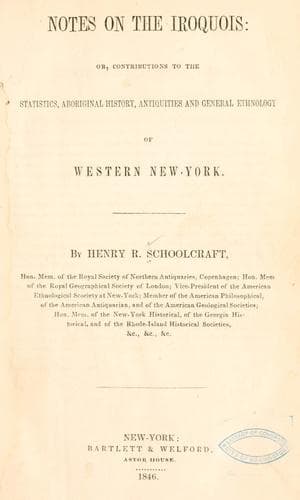
Notes on the Iroquois: or, Contributions to the Statistics, Aboriginal History, Antiquities and General Ethnology of Western New-YorkSchoolcraft, Henry Rowe
History
Notes on the Iroquois: or, Contributions to the Statistics, Aboriginal History, Antiquities and General Ethnology of Western New-York
Schoolcraft, Henry Rowe
Indians of North America -- New York (State); Iroquois Indians
Tradition, in which all concur, points out this spot as the scene of
the last and decisive battle fought between the Senecas and their
fierce and inveterate enemies the KAH-KWAHS, a people who are
generally but erroneously supposed to be the same as the Eries.[68]
It is not proposed in this place, to consider the evidences on this
point, or to denote the origin and events of this war. It is mainly
alluded to as a historical incident connected with the site. It is a
site around which the Senecas have clung, as if it marked an era in
their national history; although the work itself was clearly erected
by their enemies. It has been the seat of their government or council
fire, from an early period of our acquaintance with them. It was here
that Red Jacket uttered some of his most eloquent harangues against
the steady encroachments of the white race, and in favor of retaining
this cherished portion of their lands, and transmitting them with
full title to their descendants. It was here that the noted captive,
Dehewamis, better known as Mary Jemison, came to live after a long
life of most extraordinary vicissitudes. And it is here that the bones
of the distinguished ORATOR, and the no less distinguished
CAPTIVE, rest side by side, with a multitude of warriors,
chiefs and sages. Nor can we, on natural principles of association,
call in question the truthfulness or force of the strenuous objections,
which, for so many years, the whole tribe has opposed to the general
policy of its sale. But these events are now history; the tribe has
come into arrangements to remove to reservations owned by their
brethren, in more westerly parts of the State, and there will soon be
no one left whose heart vibrates with the blood of a Seneca, to watch
the venerated resting places of their dead.
[68] This is a French pronunciation of a Wyandot or Huron term. Vide
Hennepin, Amsterdam, ed. 1698.
It was suitable, before the plough was put into these precincts,
and the last trench and mound of the tribe were obliterated, that
some memorial of the locality should be preserved, and I can only
regret that the labor itself has not been better or more successfully
accomplished.
[Illustration: ANCIENT WORK ON BUFFALO CREEK.]
Public-domain text, read in full here on John Shaqi.
Reviews
Reviews
No reviews yet
Be the first to share your thoughts on this work.
Elsewhere in the archive
Join the Discussion
Join the discussion
Sign in to leave a comment or review.
Sign InorCreate an account