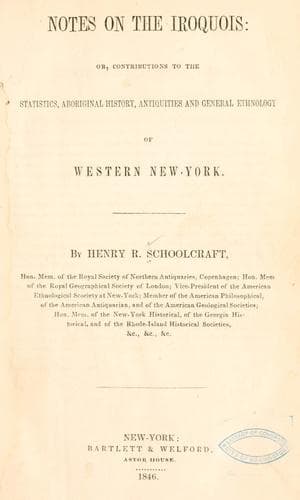
Notes on the Iroquois: or, Contributions to the Statistics, Aboriginal History, Antiquities and General Ethnology of Western New-YorkSchoolcraft, Henry Rowe
History
Notes on the Iroquois: or, Contributions to the Statistics, Aboriginal History, Antiquities and General Ethnology of Western New-York
Schoolcraft, Henry Rowe
Indians of North America -- New York (State); Iroquois Indians
A. denotes the site of the mission house; B, of the council house;
D, of the battle field, or that portion of it where the result was
consummated; F, the grave yard. At C, there are still the remains of a
mound, which tradition asserts was raised over the incinerated bodies
of victor and vanquished slain in battle. These bodies were piled
together, interspersed with the carcasses of deer and other game, which
had been hunted with the special view, that it might be offered as a
sacrifice with the bodies, or to appease their spirits in the land of
the dead. In making partial excavations into this mound, which has been
frequently plowed over in modern times, I procured several partially
charred or blackened bones, supposed to represent parts of the human
and brute species; a proof, it would seem, of the truth of this curious
part of the tradition.[69] Mixed in the funeral pile, there were set
vessels of pottery, with drinks offered as libations to the dead.
And it is certain, also, that pieces of reddish coarse pottery were
obtained at the same time, in making these partial examinations.
[69] The Indian name of Buffalo creek, which gives name to the city,
has been variously written. In the treaty of 1784, at Fort Stanwix, it
is called “Tehoseroron,” which is the Mohawk term, the final _n_ being
probably designed to convey a nasal sound. The word, as pronounced
to me by the late Mrs. Carr of Wellington square, Canada, who was a
daughter of the celebrated Brandt, I have written TEHOSERORO,
meaning Place of the Linden tree. The letters _d_ and _t_ are
interchangeable between the Mohawks and Senecas. The latter, who at the
same time do not use the letter _r_, and have some peculiarities in the
use of the vowels, pronounce it in a manner which I thought should be
written Deoseowa, as above. Mr. Wright, in his “Mental Elevator” and
“Seneca Spelling Book,” makes it a word of four syllables, and uses
the sound of _y_ as heard in “yonder,” for the vowel _e_ in his second
syllable. Every practised ear is acute to satisfy its own requisitions
of sound, which is not easy in unwritten languages; and there is
besides a marked difference in the pronunciation of Indians from
different localities, or uttered under different circumstances. Mr.
Ellicott, on his original plat of Buffalo, writes it “Tushuway.” Others
have spelt it still differently. The meaning of the word has excited
but little difference of opinion. It denotes a locality of the linden
or basswood tree, a species found upon the rich bottom lands of this
stream, whose bark was highly valuable to these tribes for covering
their lodges, and for the tough and fibrous inner coat, which at an
early time served them to make both twine and ropes.
Public-domain text, read in full here on John Shaqi.
Reviews
Reviews
No reviews yet
Be the first to share your thoughts on this work.
Elsewhere in the archive
Join the Discussion
Join the discussion
Sign in to leave a comment or review.
Sign InorCreate an account