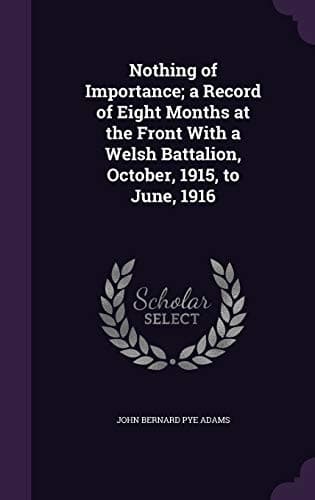
Nothing of Importance: A record of eight months at the front with a Welsh battalion, October, 1915, to June, 1916Adams, Bernard
History
Nothing of Importance: A record of eight months at the front with a Welsh battalion, October, 1915, to June, 1916
Adams, Bernard
World War, 1914-1918 -- Personal narratives, English
“No more prisoners, sir,” he answered. I then rather hurriedly
signed several returns made out by Sergeant Roberts, the company
quartermaster-sergeant, and promised to come in later and sign the
acquittance rolls. These are the pay-lists, made out in triplicate,
which are signed by each man as he draws his pay. The original goes to
the Paymaster in England, one carbon copy to the adjutant, and one is
retained by the company-commander. We had paid out the first day in
billets. This time “working-parties” had been tolerable. We had arrived
back in billets about half-past three in the afternoon; the next
morning had been spent in a march to the divisional baths at Treux (two
miles away), in cleaning up, kit-inspection, and a little arm-drill and
musketry practice; in the afternoon we paid out. Then followed three
days of working-parties, up on the support line at Crawley Ridge; and
now, we had this last day in which to do a little company work. There
had been running parade at seven-thirty. Owen had taken this, and I
confess that I had not yet breakfasted. So I hurried off now at 9.10 to
gulp something down and be at battalion orderly-room at 9.30 sharp.
The company office was a house of two rooms; one was the “office”
itself, with a blanket-clad table and a couple of chairs in the middle,
and all around were strewn strange boxes, and bundles of papers and
equipment. On the walls were pictures from illustrated English papers;
one of Nurse Cavell, another of howitzers firing; and several graphic
bayonet-charges at Verdun, pictured by an artist who must have “glowed”
as he drew them in his room in Chelsea. In the other room slept the
C.S.M. and C.Q.M.S. (more familiar as the “sergeant-major” and the
“quartermaster”).
From this house, then, I stepped out into the glaring street. It was
the end of May, and the day promised to be really quite hot. I have
already explained how completely shut off from the trenches one felt in
Morlancourt, sheltered as it was in a cup of the hills and immune from
shelling. Now as I walked quickly along the street, past our battalion
“orderly-room,” and returned the immaculate salute of Sergeant-Major
Shandon, the regimental sergeant-major, who was already marshalling the
prisoners ready for the Colonel at half-past nine, I felt a lightness
and freshness of body that almost made me think I was free of the war
at last. My Sam Browne belt, my best tunic with its polished buttons,
and most of all, I suppose, the effect of a good sleep and a cold bath,
all contributed to this feeling, as well as the scent from the laburnum
and lilac that looked over the garden wall opposite the billet that was
our “Mess.”
I found Edwards just going off to inspect “B” Company Lewis gunners,
whom he was taking on the range the first part of the morning.
“Hullo!” he said, “you’ve not got much time.”
“No,” said I. “My own fault for getting up late. Got a case for the
C.O. too. Is my watch right? I make it seventeen minutes past.”
Public-domain text, read in full here on John Shaqi.
Reviews
Reviews
No reviews yet
Be the first to share your thoughts on this work.
Elsewhere in the archive
Join the Discussion
Join the discussion
Sign in to leave a comment or review.
Sign InorCreate an account