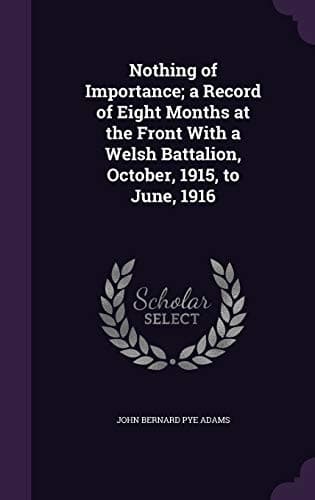
Nothing of Importance: A record of eight months at the front with a Welsh battalion, October, 1915, to June, 1916Adams, Bernard
History
Nothing of Importance: A record of eight months at the front with a Welsh battalion, October, 1915, to June, 1916
Adams, Bernard
World War, 1914-1918 -- Personal narratives, English
“Nineteen, I make it.”
“Wish I hadn’t asked you,” I laughed. “No porridge, Lewis. Bring the
eggs and bacon in at once. This tea’ll do. There’s no milk, though.
What?”
Edwards had asked something. He repeated his question, which was
whether I wanted Jim, the company horse, this afternoon. I thought
rapidly, and the scent of the lilac decided me.
“Yes,” I answered. “Sorry, but I do.”
“Oh, all right; I expect I can get old Muskett to let me have one.”
Muskett was the transport officer.
“Righto,” said I. “Go teach thy Lewis gunners how to drill little holes
in the chalk-bank.”
He clattered off over the cobbles of the garden path, and in a few
minutes I followed suit, running until I rounded a corner and came into
view of the orderly-room, when I altered my gait to a dignified walk
and arrived just as the Colonel appeared from the opposite direction.
“Parade! Tchern!!” shouted Sergeant-Major Shandon; and a moment later
the four company commanders came to attention and saluted as the
Colonel passed in, sprinkling “Good mornings” to right and left.
I had one very uninteresting case of drunkenness; “A” had a couple
of men who had overstayed their pass in England; “C” had a case held
over from the day before for further evidence, and was now dismissed as
not proven; while “D” had an unsatisfactory sergeant who was “severely
reprimanded.” All these cases were quickly and unerringly disposed of,
and we company commanders saluted again and clattered down the winding
staircase out into the sunshine.
I had to pass from one end of the village to the other. The
orderly-room was not far from our company “Mess” and was at a
cross-roads. Opposite, in one of the angles made by the junction of
the four roads, was a deep and usually muddy horse-pond. But even here
the mud was getting hard under this spell of warm May weather, and the
innumerable ruts and hoof-marks were crystallising into a permanent
pattern. As I walked along the streets I passed sundry Tommies acting
as road-scavengers; “permanent road fatigue” they were called, although
they were anything but permanent, being changed every day. Formerly
they had seemed to be engaged in a Herculean, though unromantic,
task of scraping great rolling puddings of mud to the side of the
road, in the vain hope that the mud would find an automatic exit into
neighbouring gardens and ponds; for Morlancourt did not boast such
modern things as gutters. To-day there were large pats of mud lining
the street, but these were now caked and hard, and even crumbling into
dust, that whisked about among the sparrows. The permanent road fatigue
was gathering waste-paper and tins in large quantities, but otherwise
was having a holiday.
Public-domain text, read in full here on John Shaqi.
Reviews
Reviews
No reviews yet
Be the first to share your thoughts on this work.
Elsewhere in the archive
Join the Discussion
Join the discussion
Sign in to leave a comment or review.
Sign InorCreate an account