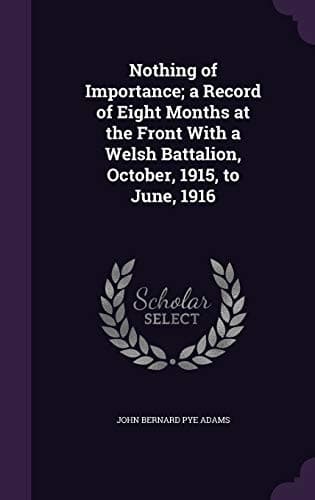
Nothing of Importance: A record of eight months at the front with a Welsh battalion, October, 1915, to June, 1916 — John Shaqi
Nothing of Importance: A record of eight months at the front with a Welsh battalion, October, 1915, to June, 1916Adams, Bernard
History
Nothing of Importance: A record of eight months at the front with a Welsh battalion, October, 1915, to June, 1916
Adams, Bernard
World War, 1914-1918 -- Personal narratives, English
Throughout October and November our battalion was in the firing-line.
This meant that we spent life in an everlasting alternation between the
trenches and our billets behind, just far enough behind, that is, to be
out of the range of the light artillery; always, though, liable to be
called suddenly into the firing-line, and never out of the atmosphere
of the trenches. Always before us was dangled a promised “rest,” and
always it was being postponed. Rumours were spread, dissected, laughed
at, and eventually treated with bored incredulity. The battalion had
had no rest, I believe, since May. Men, and especially N.C.O.‘s, who
had been out since October, 1914, were tired out in body and spirit.
With the officers and certain new drafts of men, it was different. We
came out enthusiastic and keen. On the whole, I thoroughly enjoyed
those first two months. I am surprised now to see how much detail I
wrote in my letters home. Everything was fresh, everything new and
interesting. And things were on the whole very quiet. We had a few
casualties, but underwent no serious bombardment. And, most important
to us, of course, we had no casualties among the officers.
Givenchy and Cuinchy are two small villages, north and south,
respectively, of the La Bassée Canal, which runs almost due east and
west between La Bassée and Béthune. Givenchy stands on a slight rise in
the flattest of flat countries. A church tower of red brick must have
been the most noticeable feature as one walked in pre-war days from
the suburbs of Béthune along the La Bassée road. Cuinchy is a village
straggling along a road. Both are as completely reduced to ruins as
villages can be, the firing-line running just east of them. Between
them flows the great sluggish canal.
During an afternoon in Béthune one could do all the shopping one
required, and get a hair-cut and shampoo as well. Expensive cocktails
were obtainable at the local bar; there was also a famous tea-shop. We
were billeted in one of the small villages around. Sometimes we only
stayed one night at a billet: there was always change, always movement.
Sometimes I got a bed; often I did not; but a valise is comfortable
enough, when once its tricks are mastered. Anyhow it is “billets”
and not “trenches,” that is the point; a continuous night’s rest in
pyjamas, the facilities of a bath, very often a free afternoon and
evening, and no equipment and revolver to carry night and day! It was
in billets the following letters were written, which are really the
best description of my life at this period.
“19th October, 1915. Our battalion went into the trenches on the 14th
and came out on the 17th. Our company, ‘B,’ was in support. The front
line was about 300 yards ahead, and we held the second line, everything
prepared to meet an attack in case the enemy broke through the first
line. Half-way between our first and second lines was a kind of
redoubt, to be held at all costs. Here you are:
Public-domain text, read in full here on John Shaqi.
Reviews
Reviews
No reviews yet
Be the first to share your thoughts on this work.
Join the Discussion
Join the discussion
Sign in to leave a comment or review.
Sign InorCreate an account