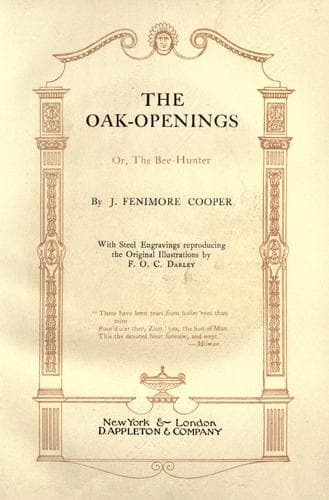
American fiction -- 19th century; Historical fiction; Indians of North America -- Fiction
Crowsfeather, and the other chiefs, advanced to meet the visitor; the
young men standing in the background, in respectful admiration. Peter
now stepped from the canoe, and greeted each of the principal men with
the courteous gravity of a savage. He shook hands with each, calling
one or two by name, a proof of the parties having met before; then
the following dialogue occurred. All spoke in the tongue of the
Pottawattamies, but, as we have had occasion to remark on previous
occasions, it is to be presumed that the reader would scarcely be able
to understand what was said, were we to record it, word for word, in the
language in which it was uttered. In consequence of this difficulty, and
for other reasons to which it may not be necessary to allude, we shall
endeavor to translate that which passed, as closely as the English
idioms will permit us so to do.
“My father is very welcome!” exclaimed Crowsfeather, who, by many
degrees, exceeded all his companions in consideration and rank. “I see
he has taken many scalps as is his practice, and that the pale-faces are
daily getting to be fewer. Will the sun ever rise on that day when their
wigwams will look like the branches of the oak in winter? Can my father
give us any hope of seeing that hour?”
“It is a long path from the salt-lake out of which the sun rises, to
that other salt-lake in which it hides itself at night. The sun sleeps
each night beneath water, but it is so hot that it is soon dried when it
comes out of its bed in the morning. This is the Great Spirit's doings,
and not ours. The sun is his sun; the Indians can warm themselves by it,
but they cannot shorten its journey a single tomahawk handle's length.
The same is true of time; it belongs to the Manitou, who will lengthen
or shorten it, as he may see fit. We are his children, and it is our
duty to submit. He has not forgotten us. He made us with his own hand,
and will no more turn us out of the land than a father will turn his
child from the wigwam.”
“We hope this is so; but it does not seem thus to out poor weak eyes,
Onoah. We count the pale-faces, and every summer they grow fast as the
grass on the prairies. We can see more when the leaf falls than when
the tree is in bud; and, then, more when the leaf is in bud than when
it falls. A few moons will put a town where the pine stood, and wigwams
drive the wolves from their homes. In a few years we shall have nothing
but dogs to eat, if the pale-face dogs do not eat us.”
“Squaws are impatient, but men know how to wait. This land was given to
the red man by the Great Spirit, as I have often told you, my children;
if he has let in the pale-faces for a few winters, it is to punish us
for having done wrong. Now that we are sorry for what we have done, he
will help us to drive away the strangers, and give us the woods again
to hunt in by ourselves. Have not messengers from our Great Father in
Montreal been among the Pottawattamies to strengthen their hearts?”
Public-domain text, read in full here on John Shaqi.
Reviews
Reviews
No reviews yet
Be the first to share your thoughts on this work.
Elsewhere in the archive
Join the Discussion
Join the discussion
Sign in to leave a comment or review.
Sign InorCreate an account