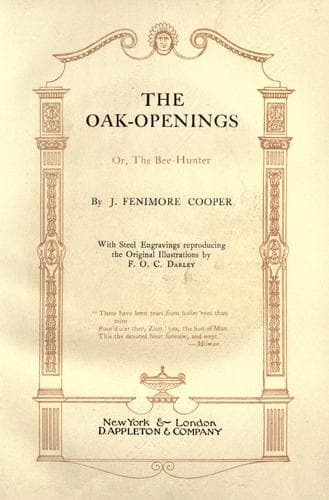
American fiction -- 19th century; Historical fiction; Indians of North America -- Fiction
At first, Peter paddled quietly on, as if he had no other object
before him than the passage of the river. When quite clear of the
rice, however, he ceased, and undid his bundle of clothes, which were
carefully put away in the knapsack of a soldier. From this repository of
his effects, the chief carefully drew forth a small bundle, on opening
which, no less than seven fresh human scalps appeared. These he arranged
in order on a wand-like pole, when, satisfied with the arrangement,
he resumed the paddle. It was apparent, from the first, that the
Pottawattamies on the north shore had seen the strange canoe when it
entered the river, and they now collected in a group, at the ordinary
landing beneath the chiente, to await its approach. Peter ceased his
own exertion, as soon as he had got within a hundred yards of the beach,
took the scalp-pole in his hand, arose, and permitted the canoe to drift
down before the wind, certain it would take the desired direction, from
the circumstance of his having placed it precisely to windward of
the landing. Once or twice he slowly waved the pole in a way to draw
attention to the scalps, which were suspended from its end, each obvious
and distinct from its companions.
Napoleon, when he returned from the campaign of Austerlitz; or
Wellington, when he entered the House of Commons to receive the thanks
of its speaker, on his return from Spain; or the chief of all the
battles of the Rio Bravo del Norte; or him of the valley of Mexico,
whose exploits fairly rival those of Cortes himself, could scarcely be a
subject of greater interest to a body of spectators, assembled to do
him honor, than was this well-known Indian, as he drew near to the
Pottawattamies, waving his scalps, in significant triumph! Glory, as the
homage paid by man to military renown is termed, was the common impulse
with them all. It is true, that, measured by the standards of reason
and right, the wise and just might find motives for appreciating the
victories of those named differently from the manner in which they are
usually regarded through the atmosphere of success; but in the common
mind it was all glory, alike. The name of “Onoah” passed in murmurs of
admiration, from mouth to mouth; for, as it appeared, the person of this
renowned Indian was recognized by many on the shore, some time ere he
reached it himself.
Public-domain text, read in full here on John Shaqi.
Reviews
Reviews
No reviews yet
Be the first to share your thoughts on this work.
Elsewhere in the archive
Join the Discussion
Join the discussion
Sign in to leave a comment or review.
Sign InorCreate an account