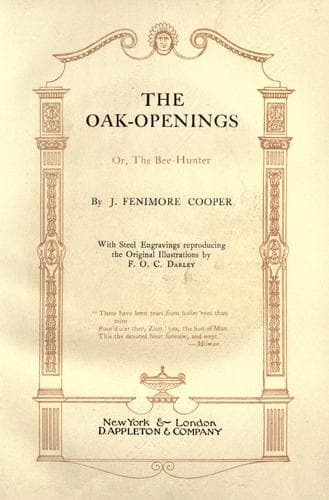
American fiction -- 19th century; Historical fiction; Indians of North America -- Fiction
We conceive that a man may be very much of a Christian, and very little
of a gentleman; or very much of a gentleman, and very little of a
Christian. There is, in short, not much in common between the two
characters, though it is possible for them to become united in the same
individual. That the finished courtesies of polished life may wear some
of the aspects of that benevolence which causes the Christian “to love
his neighbor as himself,” is certainly true, though the motives of the
parties are so very different as to destroy all real identity between
them. While the moving principle of a gentleman is self-respect, that
of a Christian is humility. The first is ready to lay down his life
in order to wipe away an imaginary dishonor, or to take the life of
another; the last is taught to turn the other cheek, when smitten. In a
word, the first keeps the world, its opinions and its estimation, ever
uppermost in his thoughts; the last lives only to reverence God, and to
conform to his will, in obedience to his revealed mandates. Certainly,
there is that which is both grateful and useful in the refined
deportment of one whose mind and manners have been polished even in the
schools of the world; but it is degrading to the profoundly beautiful
submission of the truly Christian temper, to imagine that anything like
a moral parallel can justly be run between them.
Of course, Peter had none of the qualities of him who sees and feels
his own defects, and relies only on the merits of the atonement for
his place among the children of light, while he had so many of those
qualities which depend on the estimate which man is so apt to place on
his own merits. In this last sense, this Indian had a great many of
the essentials of a gentleman; a lofty courtesy presiding over all his
intercourse with others, when passion or policy did not thrust in new
and sudden principles of action. Even the missionary was so much struck
with the gentleness of this mysterious savage's deportment in connection
with Margery, as at first to impute it to a growing desire to make a
wife of that flower of the wilderness. But closer observation induced
greater justice to the Indian in this respect Nothing like the
uneasiness, impatience, or distrust of passion could be discerned in his
demeanor; and when Parson Amen perceived that the bee-hunter's marked
devotion to the beautiful Blossom rather excited a benevolent and kind
interest in the feelings of Peter, so far at least as one could judge
of the heart by external appearances, than anything that bore the fierce
and uneasy impulses of jealousy, he was satisfied that his original
impression was a mistake.
Public-domain text, read in full here on John Shaqi.
Reviews
Reviews
No reviews yet
Be the first to share your thoughts on this work.
Elsewhere in the archive
Join the Discussion
Join the discussion
Sign in to leave a comment or review.
Sign InorCreate an account