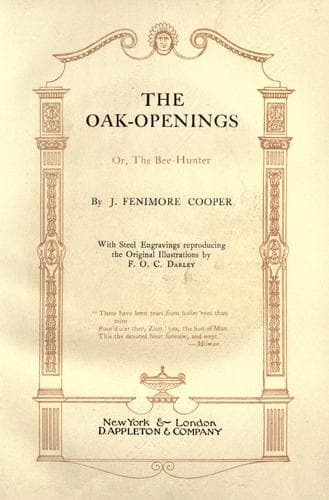
American fiction -- 19th century; Historical fiction; Indians of North America -- Fiction
As le Bourdon flourished his axe, and Margery plied her needles, making
a wholesome provision for the coming winter, the mysterious Indian would
stand, a quarter of an hour at a time, immovable as a statue, his eyes
riveted first on one, and then on the other. What passed at such moments
in that stern breast, it exceeds the penetration of man to say: but that
the emotions thus pent within barriers that none could pass or destroy,
were not always ferocious and revengeful, a carefully observant
spectator might possibly have suspected, had such a person been there to
note all the signs of what was uppermost in the chiefs thoughts. Still,
gleamings of sudden, but intense ferocity did occasionally occur; and,
at such instants, the countenance of this extraordinary being was
truly terrific. Fortunately, such bursts of uncontrollable feeling were
transient, being of rare occurrence, and of very short duration.
By the time the corporal had his trenches dug, le Bourdon was prepared
with his palisades, which were just one hundred in number, being
intended to enclose a space of forty feet square. The men all united in
the transportation of the timber, which was floated down the river on a
raft of white pine, the burr-oak being of a specific gravity that fresh
water would not sustain. A couple of days, however, sufficed for the
transportation by water, and as many more for that by land, between
the place of landing and Castle Meal. This much accomplished, the
whole party rested from their labors, the day which succeeded being the
Sabbath.
Those who dwell habitually amid the haunts of men, alone thoroughly
realize the vast importance that ought to be attached to the great day
of rest. Men on the ocean, and men in the forest, are only too apt
to overlook the returns of the Sabbath; thus slowly, but inevitably
alienating themselves more and more from the dread Being who established
the festival, as much in his own honor as for the good of man. When we
are told that the Almighty is jealous of his rights, and desires to
be worshipped, we are not to estimate this wish by any known human
standard, but are ever to bear in mind that it is exactly in proportion
as we do reverence the Creator and Ruler of heaven and earth that we are
nearest, or farthest, from the condition of the blessed. It is probably
for his own good, that the adoration of man is pleasing in the eyes of
God.
Public-domain text, read in full here on John Shaqi.
Reviews
Reviews
No reviews yet
Be the first to share your thoughts on this work.
Elsewhere in the archive
Join the Discussion
Join the discussion
Sign in to leave a comment or review.
Sign InorCreate an account