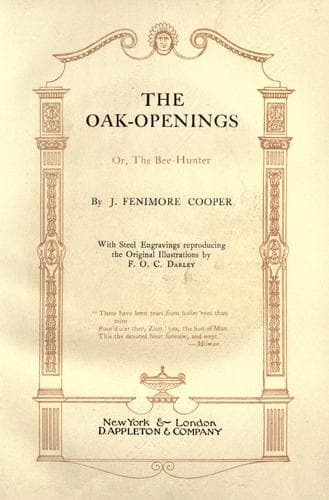
American fiction -- 19th century; Historical fiction; Indians of North America -- Fiction
“More! Aye, a thousand times more, Chippewa. Where you could show one
warrior, we could show a thousand!”
Now, this was not strictly true, perhaps, but it answered the purpose
of deeply impressing the Chippewa with the uselessness of Peter's plans,
and sustained as it was by his early predilections, it served to
keep him on the right side, in the crisis which was approaching. The
discourse continued, much in the same strain, until the men got in with
their bear's meat, having been preceded some time by the others, with
the venison.
It is a little singular that neither the questions, nor the manner of
Pigeonswing, awakened any distrust in the bee-hunter. So far from this,
the latter regarded all that had passed as perfectly natural, and as
likely to arise in conversation, in the way of pure speculation, as in
any other manner. Pigeonswing intended to be guarded in what he said and
did, for, as yet, he had not made up his mind which side he would really
espouse, in the event of the great project coming to a head. He had the
desire, natural to a red man, to avenge the wrongs committed against
his race; but this desire existed in a form a good deal mitigated by his
intercourse with the “Yankees,” and his regard for individuals. It had,
nevertheless, strangely occurred to the savage reasoning of this young
warrior that possibly some arrangement might be effected, by means of
which he should take scalps from the Canadians, while Peter and his
other followers were working their will on the Americans. In this
confused condition was the mind of the Chippewa, when he and his
companion threw down their loads, near the place where the provision of
game was usually kept. This was beneath the tree, near the spring and
the cook-house, in order that no inconvenience should arise from its
proximity to the place where the party dwelt and slept. For a siege,
should there be occasion to shut themselves up within the “garrison,”
the men depended on the pickled pork, and a quantity of dried meat; of
the latter of which the missionary had brought a considerable supply
in his own canoe. Among these stores were a few dozen of buffaloes'
or bisons' tongues, a delicacy that would honor the best table in the
civilized world, though then so common among the western hunters, as
scarce to be deemed food as good as the common salted pork and beef of
the settlements.
The evening that followed proved to be one of singular softness and
sweetness. The sun went down in a cloudless sky, and gentle airs from
the southwest fanned the warm cheeks of Margery, as she sat, resting
from the labors of the day, with le Bourdon at her side, speaking of the
pleasures of a residence in such a spot. The youth was eloquent, for he
felt all that he said, and the maiden was pleased. The young man could
expatiate on bees in a way to arrest any one's attention; and Margery
delighted to hear him relate his adventures with these little creatures;
his successes, losses, and journeys.
Public-domain text, read in full here on John Shaqi.
Reviews
Reviews
No reviews yet
Be the first to share your thoughts on this work.
Elsewhere in the archive
Join the Discussion
Join the discussion
Sign in to leave a comment or review.
Sign InorCreate an account