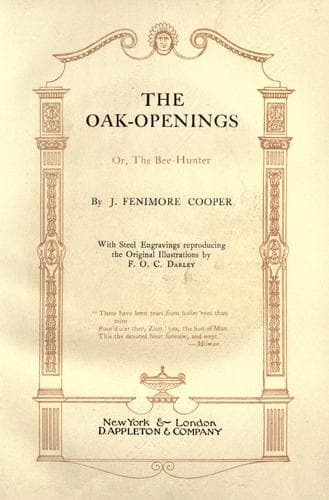
American fiction -- 19th century; Historical fiction; Indians of North America -- Fiction
“But are you not often lonely, Bourdon, living here in the openings,
whole summers at a time, without a living soul to speak to?” demanded
Margery, coloring to the eyes, the instant the question was asked,
lest it should subject her to an imputation against which her modesty
revolted, that of wishing to draw the discourse to a discussion on the
means of preventing this solitude in future.
“I have not been, hitherto,” answered le Bourdon, so frankly as at once
to quiet his companion's sensitiveness, “though I will not answer for
the future. Now that I have so many with me, we may make some of them
necessary. Mind--I say SOME, not all of my present guests. If I could
have my pick, pretty Margery, the present company would give me ALL I
can desire, and more too. I should not think of going to Detroit for
that companion, since she is to be found so much nearer.”
Margery blushed, and looked down--then she raised her eyes, smiled,
and seemed grateful as well as pleased. By this time she had become
accustomed to such remarks, and she had no difficulty in discovering her
lover's wishes, though he had never been more explicit. The reflections
natural to her situation threw a shade of gentle seriousness over her
countenance, rendering her more charming than ever, and causing the
youth to plunge deeper and deeper into the meshes that female influence
had cast around him, In all this, however, one of the parties was
governed by a manly sincerity, and the other by girlish artlessness.
Diffidence, one of the most certain attendants of a pure passion, alone
kept le Bourdon from asking Margery to become his wife; while Margery
herself sometimes doubted whether it were possible that any reputable
man could wish to connect himself and his fortunes with a family that
had sunk as low as persons could well sink, in this country, and not
lose their characters altogether. With these doubts and distrusts, so
naturally affecting the mind of each, these young people were rapidly
becoming more and more enamored; the bee-hunter betraying his passion
in the close, absorbed attentions that more properly belong to his sex,
while that of Margery was to be seen in sudden blushes, the thoughtful
brow, the timid glance, and a cast of tenderness that came over her
whole manner, and, as it might be, her whole being.
While our young folk were thus employed, now conversing cheerfully, now
appearing abstracted and lost in thought, though seated side by side,
le Bourdon happened to look behind him, and saw that Peter was regarding
them with one of those intense, but mysterious expressions of the
countenance, that had, now, more than once attracted his attention;
giving reason, each time, for a feeling in which doubt, curiosity, and
apprehension were singularly mingled, even in himself.
Public-domain text, read in full here on John Shaqi.
Reviews
Reviews
No reviews yet
Be the first to share your thoughts on this work.
Elsewhere in the archive
Join the Discussion
Join the discussion
Sign in to leave a comment or review.
Sign InorCreate an account