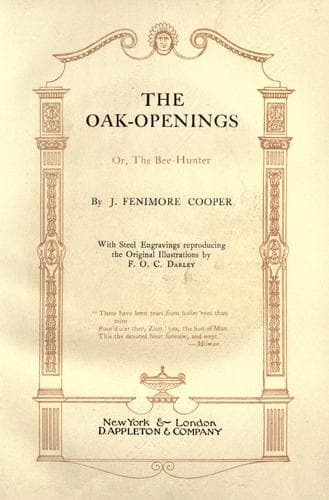
American fiction -- 19th century; Historical fiction; Indians of North America -- Fiction
“Forward,” returned the corporal, wheeling short in the direction of
the dog; “one thing should be understood, however, Bourdon, which is
this--you must act as light troops in this sortie, and I as the main
body. If we come on the inimy, it will be your duty to skrimmage in
front as long as you can, and then fall back on your resarves. I shall
depend chiefly on the baggonet, which is the best tool to put an Injin
up with; and as he falls back, before my charge, we must keep him under
as warm a fire as possible. Having no cavalry, the dog might be made
useful in movements to the front and on our flanks.”
“Pooh, pooh, corporal, you're almost as much set in the notions of your
trade as Parson Amen is set in his idees about the lost tribes. In
my opinion there'll be more tribes FOUND in these openings before the
summer is over than we shall wish to meet. Let us follow the dog, and
see what will turn up.” Hive WAS followed, and he took a direction that
led to a distant point in the openings, where not only the trees were
much thicker than common, but where a small tributary of the Kalamazoo
ran through a ravine, from the higher lands adjacent into the main
artery of all the neighboring watercourses. The bee-hunter knew the
spot well, having often drank at the rivulet, and cooled his brow in the
close shades of the ravine, when heated by exertions in the more
open grounds. In short, the spot was one of the most eligible for
concealment, coolness, and pure water, within several miles of Castle
Meal. The trees formed a spacious grove around it, and, by means of the
banks, their summits and leaves answered the purpose of a perfect screen
to those who might descend into the ravine, or, it would be better to
say, to the bottom. Le Bourdon was no sooner satisfied that his mastiff
was proceeding toward the great spring which formed the rivulet at the
head of the ravine mentioned, than he suspected Indians might be there.
He had seen signs about the spot, which wore an appearance of its having
been used as a place of encampment--or for “camping out,” as it is
termed in the language of the west--and, coupling the sound of the horn
with the dog's movements, his quick apprehension seized on the facts as
affording reasonable grounds of distrust. Consequently he resorted to
great caution, as he and the corporal entered the wood which surrounded
the spring, and the small oval bit of bottom that lay spread before it,
like a little lawn. Hive was kept close at his master's side, though
he manifested a marked impatience to advance. “Now, corporal,” said the
bee-hunter in a low tone, “I think we have lined some savages to their
holes. We will go round the basin and descend to the bottom, in a close
wood which grows there. Did you see that?”
“I suppose I did,” answered the corporal, who was as firm as a rock.
“You meant to ask me if I saw fire?”
Public-domain text, read in full here on John Shaqi.
Reviews
Reviews
No reviews yet
Be the first to share your thoughts on this work.
Elsewhere in the archive
Join the Discussion
Join the discussion
Sign in to leave a comment or review.
Sign InorCreate an account