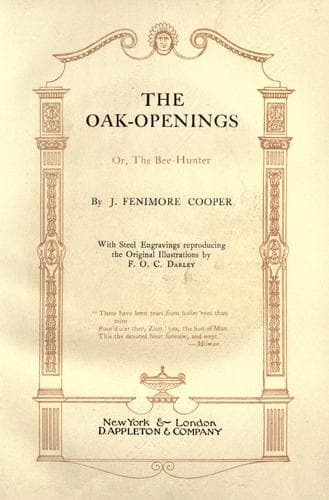
American fiction -- 19th century; Historical fiction; Indians of North America -- Fiction
Hive was no sooner admitted to the “garrison,” than he manifested just
as strong a desire to get out, as a moment before he had manifested
to get in. This, le Bourdon well knew, indicated the presence of some
thing, or creature, that did not properly belong to the vicinity. After
consulting with the corporal, Pigeonswing was called; and leaving him as
a sentinel at the gate, the two others made a sortie. The corporal
was as brave as a lion, and loved all such movements, though he fully
anticipated encountering savages, while his companion expected an
interview with bears.
As this movement was made at the invitation of the dog, it was
judiciously determined to let him act as pioneer, on the advance.
Previously to quitting the defences, however, the two adventurers looked
closely to their arms. Each examined the priming, saw that his horn
and pouch were accessible, and loosened his knife in its sheath. The
corporal, moreover, fixed his “baggonet,” as he called the formidable,
glittering instrument that usually embellished the end of his musket--a
MUSKET being the weapon he chose to carry, while the bee-hunter himself
was armed with a long western RIFLE.
CHAPTER XVI.
The raptures of a conqueror's mood
Rushed burning through his frame;
The depths of that green solitude
Its torrents could not tame,
Though stillness lay, with eve's last smile,
Round those far fountains of the Nile
--MRS HEMANS.
When the bee-hunter and Corporal Flint thus went forth in midnight, from
the “garrison” of Castle Meal (Chateau au Miel), as the latter would
have expressed it, it was with no great apprehension of meeting any
other than a four-footed enemy, notwithstanding the blast of the horn
the worthy corporal supposed he had heard. The movements of the dog
seemed to announce such a result rather than any other, for Hive was
taken along as a sort of guide. Le Bourdon, however, did not permit his
mastiff to run off wide, but, having the animal at perfect command, it
was kept close to his own person.
The two men first moved toward the grove of the Kitchen, much to Hive's
discontent. The dog several times halted, and he whined, and growled,
and otherwise manifested his great dislike to proceed in that direction.
At length so decided did his resistance become, that his master said to
his companion:
“It seems to me best, corporal, to let the mastiff lead us. I have never
yet seen him so set on not going in one way, and on going in another.
Hive has a capital nose, and we may trust him.”
Public-domain text, read in full here on John Shaqi.
Reviews
Reviews
No reviews yet
Be the first to share your thoughts on this work.
Elsewhere in the archive
Join the Discussion
Join the discussion
Sign in to leave a comment or review.
Sign InorCreate an account