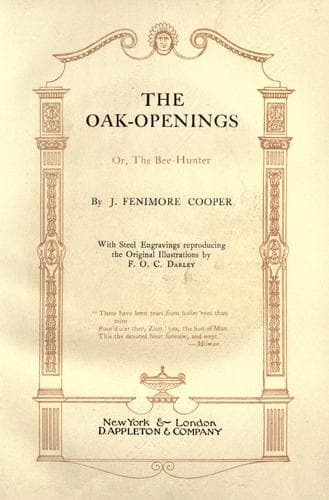
American fiction -- 19th century; Historical fiction; Indians of North America -- Fiction
Here Peter, who as yet had spoken only in a low and barely audible
voice, suddenly paused, in order to allow the idea he had just thrown
out to work on the minds of his listeners. That it was producing its
effect was apparent by the manner in which one stern face turned toward
another, and eye seemed to search in eye some response to a query that
the mind suggested, though no utterance was given to it with the tongue.
As soon, however, as the orator thought time sufficient to impress
that thought on the memories of the listeners had elapsed, he resumed,
suffering his voice gradually to increase in volume, as he warmed with
his subject.
“Yes,” he continued, “the Manitou has been very kind. Who is the
Manitou? Has any Indian ever seen him? Every Indian has seen him. No one
can look on the hunting-grounds, on the lakes, on the prairies, on the
trees, on the game, without seeing his hand. His face is to be seen in
the sun at noonday; his eyes in the stars at night. Has any Indian
ever heard the Manitou? When it thunders, he speaks. When the crash is
loudest, then he scolds. Some Indian has done wrong. Perhaps one red man
has taken another red man's scalp!”
Another pause succeeded, briefer, and less imposing than the first, but
one that sufficed to impress on the listeners anew, the great evil of an
Indian's raising his hand against an Indian.
“Yes, there is no one so deaf as not to hear the voice of the Great
Spirit when he is angry,” resumed Peter. “Ten thousands of buffalo
bulls, roaring together, do not make as much noise as his whisper.
Spread the prairies, and the openings, and the lakes, before him, and he
can be heard in all, and on all, at the same time.
“Here is a medicine-priest of the pale-faces; he tells me that the voice
of the Manitou reaches into the largest villages of his people, beneath
the rising sun, when it is heard by the red man across the great lakes,
and near the rocks of the setting sun. It is a loud voice; woe to him
who does not remember it. It speaks to all colors, and to every people,
and tribe, and nation.
“Brothers, that is a lying tradition which says, there is one Manitou
for a Sac, and another for the Ojebway--one Manitou for the red man, and
another for the pale-face. In this, we are alike. One Great Spirit
made all; governs all; rewards all; punishes all. He may keep the happy
hunting-grounds of an Indian separate from the white man's heaven,
for he knows that their customs are different, and what would please a
warrior would displease a trader; and what would please a trader would
displease a warrior. He has thought of these things, and has made
several places for the spirits of the good, let their colors be what
they may. Is it the same with the places of the spirits of the bad? I
think not. To me it would seem best to let THEM go together, that they
may torment one another. A wicked Indian and a wicked pale-face would
make a bad neighborhood. I think the Manitou will let THEM go together.
Public-domain text, read in full here on John Shaqi.
Reviews
Reviews
No reviews yet
Be the first to share your thoughts on this work.
Elsewhere in the archive
Join the Discussion
Join the discussion
Sign in to leave a comment or review.
Sign InorCreate an account