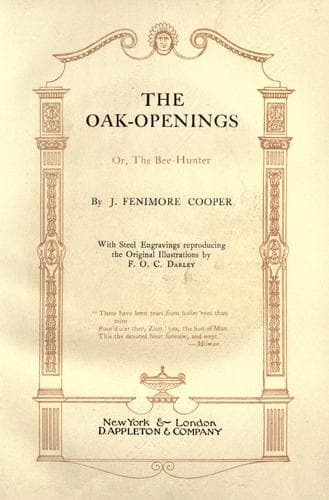
American fiction -- 19th century; Historical fiction; Indians of North America -- Fiction
“Brothers, if the Manitou keeps the good Indian and the good pale-face
apart in another world, what has brought them together in this? If he
brings the bad spirits of all colors together in another world, why
should they come together here, before their time? A place for wicked
spirits should not be found on earth. This is wrong; it must be looked
into.
“Brothers, I have now done; this pale-face wishes to speak, and I have
said that you would hear his words. When he has spoken his mind, I
may have more to tell you. Now, listen to the stranger. He is a
medicine-priest of the white men, and says he has a great secret to tell
our people--when he has told it, I have another for their ears too. Mine
must be spoken when there is no one near but the children of red clay.”
Having thus opened the way for the missionary, Peter courteously took
his seat, producing a little disappointment among his own admirers,
though he awakened a lively curiosity to know what this medicine-priest
might have to say on an occasion so portentous. The Indians in the
regions of the great lakes had long been accustomed to missionaries, and
it is probable that even some of their own traditions, so far as they
related to religious topics, had been insensibly colored by, if not
absolutely derived from, men of this character; for the first whites
who are known to have penetrated into that portion of the continent were
Jesuits, who carried the cross as their standard and emblem of peace.
Blessed emblem! that any should so confound their own names and
denunciatory practices with the revealed truth, as to imagine that a
standard so appropriate should ever be out of season and place, when it
is proper for man to use aught, at all, that is addressed to his senses,
in the way of symbols, rites, and ceremonies! To the Jesuits succeeded
the less ceremonious and less imposing priesthood of America, as America
peculiarly was in the first years that followed the Revolution. There is
reason to believe that the spirit of God, in a greater or less degree,
accompanied all; for all were self-denying and zealous, though the
fruits of near two centuries of labor have, as yet, amounted to little
more than the promise of the harvest at some distant day. Enough,
however, was known of the missionaries, and their views in general,
to prepare the council, in some small degree, for the forthcoming
exhibition.
Parson Amen had caught some of the habits of the Indians, in the course
of years of communication and intercourse. Like them he had learned to
be deliberate, calm, and dignified in his exterior; and, like them, he
had acquired a sententious mode of speaking.
Public-domain text, read in full here on John Shaqi.
Reviews
Reviews
No reviews yet
Be the first to share your thoughts on this work.
Elsewhere in the archive
Join the Discussion
Join the discussion
Sign in to leave a comment or review.
Sign InorCreate an account