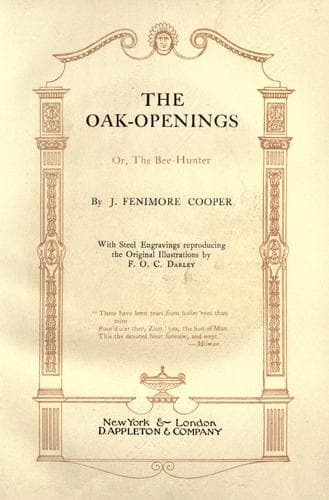
American fiction -- 19th century; Historical fiction; Indians of North America -- Fiction
One of the great stumbling-blocks with a large class of well-meaning,
but narrow-judging moralists, are the seeming wrongs that are permitted
by Providence, in its control of human events. Such persons take a
one-sided view of things, and reduce all principles to the level of
their own understandings. If we could comprehend the relations which the
Deity bears to us, as well as we can comprehend the relations we bear
to him, there might be a little seeming reason in these doubts; but when
one of the parties in this mighty scheme of action is a profound mystery
to the other, it is worse than idle, it is profane, to attempt to
explain those things which our minds are not yet sufficiently cleared
from the dross of earth to understand. Look at Italy, at this very
moment. The darkness and depression from which that glorious peninsula
is about to emerge are the fruits of long-continued dissensions and an
iron despotism, which is at length broken by the impulses left behind
him by a ruthless conqueror, who, under the appearance and the phrases
of Liberty, contended only for himself. A more concentrated egotism than
that of Napoleon probably never existed; yet has it left behind it seeds
of personal rights that have sprung up by the wayside, and which are
likely to take root with a force that will bid defiance to eradication.
Thus is it ever, with the progress of society. Good appears to arise
out of evil, and the inscrutable ways of Providence are vindicated by
general results, rather than by instances of particular care. We leave
the application of these remarks to the intelligence of such of our
readers as may have patience to peruse the work that will be found in
the succeeding pages.
We have a few words of explanation to say, in connection with the
machinery of our tale. In the first place, we would remark, that the
spelling of “burr-oak,” as given in this book, is less our own than
an office spelling. We think it should be “bur-oak,” and this for the
simple reason, that the name is derived from the fact that the acorn
borne by this tree is partially covered with a bur. Old Sam Johnson,
however, says that “burr” means the lobe, or lap of the ear; and those
who can fancy such a resemblance between this and the covering of our
acorn, are at liberty to use the two final consonants. Having commenced
stereotyping with this supernumerary, for the sake of uniformity that
mode of spelling, wrong as we think it, has been continued through-out
the book.
Public-domain text, read in full here on John Shaqi.
Reviews
Reviews
No reviews yet
Be the first to share your thoughts on this work.
Join the Discussion
Join the discussion
Sign in to leave a comment or review.
Sign InorCreate an account