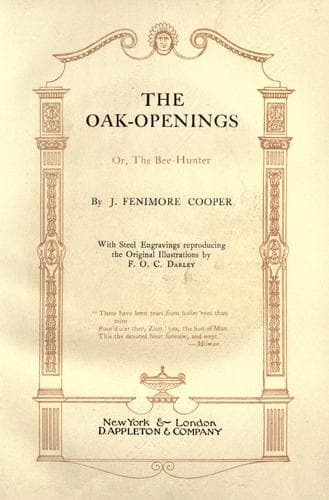
American fiction -- 19th century; Historical fiction; Indians of North America -- Fiction
“My brother does not understand me. No man can see into the future--no
man can say what will happen to-morrow. The Great Spirit only can tell.
It is for him, then, to guide his children in their wanderings. When our
fathers first came out of their canoes upon the land, on this side of
the great salt lake, not one among them knew anything of this country
between the great lakes of sweet water. They did not know that red men
lived here. The Great Spirit did know, and intended then, that I should
this night stand up in this council, and speak of his power and of his
name, and do him reverence. It was the Great Spirit that put it into my
mind to come among the Indians; and it is the Great Spirit who has led
me, step by step, as warriors move toward the graves of their fathers,
to make the discovery, that the Indians are, in truth, the children of
Israel, a part of his own chosen and once much-favored people. Let me
ask my friends one or two questions. Do not your traditions say that
your fathers once came from a far-off land?”
Bear's Meat now took his seat, not choosing to answer a question of
this nature, in the presence of a chief so much respected as Peter. He
preferred to let the last take up the dialogue where he now saw fit to
abandon it. As the other very well understood the reason of this sudden
movement, he quietly assumed the office of spokesman; the whole affair
proceeding much as if there had been no change.
“Our traditions DO tell us that our fathers came from a far-off land,”
answered Peter, without rising.
“I thought so!--I thought so!” exclaimed the simple-minded and confiding
missionary. “How wonderful are the ways of God! Yes, my brother, Judea
is a far-off land, and your traditions say that your fathers came from
such a distance! This, then, is something proved. Do not your traditions
say, that once your tribes were more in favor with the Great Spirit than
they are now?”
“Our traditions do say this: once our tribes did not see the face of
the Manitou looking dark upon them, as it now does. That was before
the pale-faces came in their big canoes, across the great salt lake, to
drive the Indians from their hunting-grounds. It was when the small-pox
had not found the path to their villages. When fire-water was unknown to
them, and no Indian had ever burned his throat with it.”
“Oh, but I speak of a time much more distant than that. Of a time when
your prophets stood face to face with God, and talked with the Creator.
Since that day a great change has come over your people. Then your color
was light, like that of the fairest and handsomest of the Circassian
race; now, it has become red. When even the color is changed, it is not
wonderful that men should no longer be the same in other particulars.
Yes; once all the races of men were of the same color and origin.”
Public-domain text, read in full here on John Shaqi.
Reviews
Reviews
No reviews yet
Be the first to share your thoughts on this work.
Elsewhere in the archive
Join the Discussion
Join the discussion
Sign in to leave a comment or review.
Sign InorCreate an account