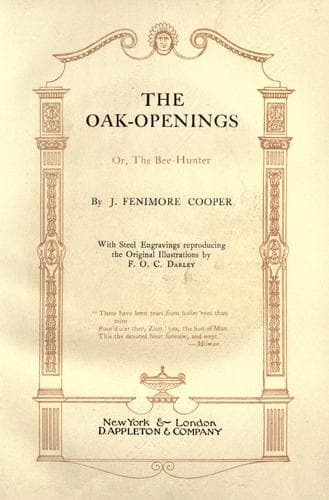
American fiction -- 19th century; Historical fiction; Indians of North America -- Fiction
“This is not what our traditions say. We have heard from our fathers
that the Great Spirit made men of different colors; some he made light,
like the pale-faces; some red, like the Injins; some black, like the
pale-faces' slaves. To some he gave high noses; to some low noses: to
some flat noses. To the pale-faces he gave eyes of many colors. This is
the reason why they see so many things, and in so many different ways.
To the red men he gave eyes of the same color, and they always see
things of the same color. To a red man there is no change. Our fathers
have always been red. This we know. If them Jews, of whom my brother
speaks, were ever white, they have not been our fathers. We tell this to
the medicine-man, that he may know it, too. We do not wish to lead him
on a crooked path, or to speak to him with a forked tongue. What we have
said, is so. Now, the road is open to the wigwam of the pale-faces, and
we wish them safe on their journey home. We Injins have a council to
hold around this fire, and will stay longer.”
At this plain intimation that their presence was no longer desirable, it
became necessary for them to depart. The missionary, filled with zeal,
was reluctant to go, for, in his eyes, the present communications with
the savages promised him not only the conversion of pagans, but the
restoration of the Jews! Nevertheless, he was compelled to comply; and
when le Bourdon and the corporal took their departure, he turned, and
pronounced in solemn tone the Christian benediction on the assembly.
The meaning of this last impressive office was understood by most of the
chiefs, and they rose as one man, in acknowledgment.
The three white men, on retiring from the circle, held their way toward
Castle Meal. Hive followed his master, having come out of the combat but
little injured. As they got to a point where a last look could be had of
the bottom-land of the council, each turned to see what was now in the
course of proceeding. The fire glimmered just enough to show the circlet
of dark faces, but not an Indian spoke or moved. There they all sat,
patiently waiting for the moment when the “strangers” might “withdraw”
to a sufficient distance, to permit them to proceed with their own
private affairs without fear of interruption.
“This has been to me a most trying scene,” observed the missionary,
as the three pursued their way toward the garrison. “How hard it is to
convince men against their wishes. Now, I am as certain as a man can be,
that every one of these Injins is in fact a Jew; and yet, you have seen
how small has been my success in persuading them to be of the right way
of thinking, on this subject.”
Public-domain text, read in full here on John Shaqi.
Reviews
Reviews
No reviews yet
Be the first to share your thoughts on this work.
Elsewhere in the archive
Join the Discussion
Join the discussion
Sign in to leave a comment or review.
Sign InorCreate an account