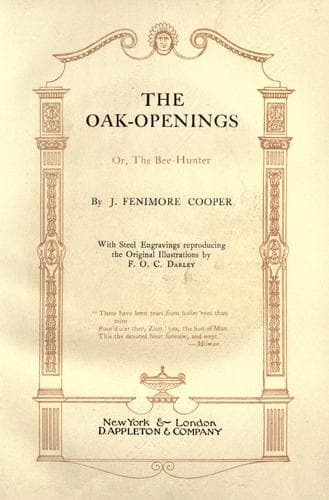
American fiction -- 19th century; Historical fiction; Indians of North America -- Fiction
This speech was received with general favor. The notion that the Indians
were not Indians, but Jews, was far from being agreeable to those
who had heard what had been said on the subject; and the opinions of
Crowsfeather possessed the great advantage of reflecting the common
sentiment on this interesting subject. When this is the case, a very
little eloquence or logic goes a great way; and, on the whole, the
address of the last speaker was somewhat better received than that of
the first.
It was now confidently believed that Peter would rise. But he did
not. That mysterious chief was not yet prepared to speak, or he was
judiciously exciting expectation by keeping back. There were at least
ten minutes of silent smoking, ere a chief, whose name rendered into
English was Bough of the Oak, arose, evidently with a desire to help
the time along. Taking his cue from the success of Crows-feather, he
followed up the advantage obtained by that chief, assailing the theory
of the missionary from another quarter.
“I am an Injin,” said Bough of the Oak; “my father was an Injin, and my
mother was the daughter of an Injin. All my fathers were red men,
and all their sons. Why should I wish to be anything else? I asked my
brother, the medicine-priest, and he owned that Jews are pale-faces.
This he should not have owned if he wished the Injins to be Jews. My
skin is red. The Manitou of my fathers so painted it, and their child
will not try to wash out the color. Were the color washed out of my
face, I should be a pale-face! There would not be paint enough to hide
my shame. No; I was born red, and will die a red man. It is not good to
have two faces. An Injin is not a snake, to cast his skin. The skin in
which he was born he keeps. He plays in it when a child; he goes in it
to his first hunt; the bears and the deer know him by it; he carries it
with him on the warpath, and his enemies tremble at the sight of it; his
squaw knows him by that skin when he comes back to his wigwam; and when
he dies, he is put aside in the same skin in--which he was born. There
is but one skin, and it has but one color. At first, it is little. The
pappoose that wears it is little. There is not need of a large skin.
But it grows with the pappoose, and the biggest warrior finds his skin
around him. This is because the Great Spirit fitted it to him. Whatever
the Manitou does is good.
“My brothers have squaws--they have pappooses. When the pappoose is put
into their arms, do they get the paint-stones, and paint it red? They do
not. It is not necessary. The Manitou painted it red before it was born.
How this was done I do not know. I am nothing but a poor Injin, and only
know what I see. I have seen that the pappooses are red when they are
born, and that the warriors are red when they die. They are also
red while living. It is enough. Their fathers could never have been
pale-faces, or we should find some white spots on their children. There
are none.
Public-domain text, read in full here on John Shaqi.
Reviews
Reviews
No reviews yet
Be the first to share your thoughts on this work.
Elsewhere in the archive
Join the Discussion
Join the discussion
Sign in to leave a comment or review.
Sign InorCreate an account