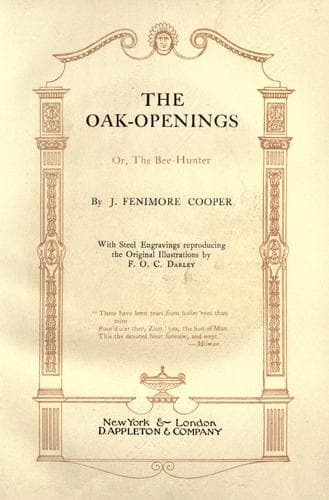
American fiction -- 19th century; Historical fiction; Indians of North America -- Fiction
“Crowsfeather has spoken of the Jews as lost. I am not surprised to hear
it. It seems to me that all pale-faces get lost. They wander from
their own hunting-grounds into those of other people. It is not so with
Injins. The Pottawattamie does not kill the deer of the Iowa, nor the
Ottawa the deer of the Menomenees. Each tribe knows its own game. This
is because they are not lost. My pale-face father appears to wish us
well. He has come on a long and weary path to tell us about his Manitou.
For this I thank him. I thank all who wish to do me good. Them that wish
to do me harm I strike from behind. It is our Injin custom. I do not
wish to hurt the medicine-priest, because I think he wishes to do me
good, and not to do me harm. He has a strange law. It is to do good to
them that do harm to you. It is not the law of the red men. It is not
good law. I do not wonder that the tribes which follow such a law get
lost. They cannot tell their friends from their enemies. They can have
no people to scalp. What is a warrior if he cannot find someone to
scalp? No; such a law would make women of the bravest braves in the
Openings, or on the prairie. It may be a good law for Jews, who get
lost; but it is a bad law for Injins, who know the paths they travel.
Let another speak.”
This brief profession of faith, on the subject that had been so recently
broached in the council, seemed to give infinite satisfaction. All
present evidently preferred being red men, who knew where they were,
than to be pale-faces who had lost their road. Ignorance of his path is
a species of disgrace to an American savage, and not a man there would
have confessed that his particular division of the great human family
was in that dilemma. The idea that the Yankees were “lost,” and had got
materially astray, was very grateful to most who heard it; and Bough of
the Oak gained a considerable reputation as an orator, in consequence of
the lucky hits made on this occasion.
Another long, ruminating pause, and much passing of the pipe of peace
succeeded. It was near half an hour after the last speaker had resumed
his seat, ere Peter stood erect. In that long interval expectation had
time to increase, and curiosity to augment itself. Nothing but a very
great event could cause this pondering, this deliberation, and this
unwillingness to begin. When, however, the time did come for the
mysterious chief to speak, the man of many scalps to open his mouth,
profound was the attention that prevailed among all present. Even after
he had arisen, the orator stood silently looking around him, as if the
throes of his thoughts had to be a little suppressed before he could
trust his tongue to give them utterance.
Public-domain text, read in full here on John Shaqi.
Reviews
Reviews
No reviews yet
Be the first to share your thoughts on this work.
Elsewhere in the archive
Join the Discussion
Join the discussion
Sign in to leave a comment or review.
Sign InorCreate an account