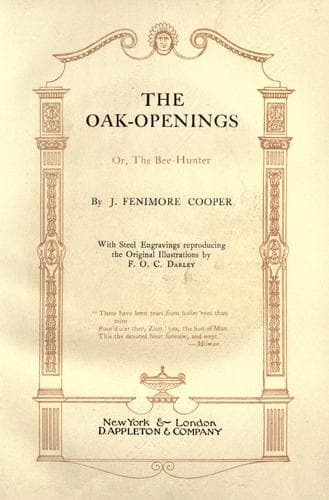
American fiction -- 19th century; Historical fiction; Indians of North America -- Fiction
Ungque now slowly seated himself. He had spoken with great moderation,
as to manner; and with such an air of humility as one of our own
demagogues is apt to assume, when he tells the people of their virtues,
and seems to lament the whole time that he, himself, was one of the
meanest of the great human family. Peter saw, at once, that he had
a cunning competitor, and had a little difficulty in suppressing
all exhibition of the fiery indignation he actually felt, at meeting
opposition in such a quarter. Peter was artful, and practised in all
the wiles of managing men, but he submitted to use his means to attain a
great end. The virtual extinction of the white race was his object, and
in order to effect it, there was little he would have hesitated to do.
Now, however, when for the first time in many years a glimmering of
human feeling was shining on the darkness of his mind, he found himself
unexpectedly opposed by one of those whom he had formerly found so
difficult to persuade into his own dire plans! Had that one been a chief
of any renown, the circumstances would have been more tolerable; but
here was a man presuming to raise his voice against him, who, so far as
he knew anything of his past career, had not a single claim to open his
mouth in such a council. With a volcano raging within, that such a state
of things would be likely to kindle in the breast of a savage who had
been for years a successful and nearly unopposed leader, the mysterious
chief rose to reply.
“My brother says he is a weasel,” observed Peter, looking round at the
circle of interested and grave countenances by which he was surrounded.
“That is a very small animal. It creeps through very small holes, but
not to do good. It is good for nothing. When it goes through a small
hole, it is not to do the Injins a service, but for its own purposes. I
do not like weasels.
“My brother is not afraid of a bee-hunter. Can HE tell us what a bee
whispers? If he can, I wish he would tell us. Let him show our young men
where there is more honey--where they can find bear's meat for another
feast--where they can find warriors hid in the woods.
“My brother says the bee-hunter has no squaw. How does he know this? Has
he lived in the lodge with them--paddled in the same canoe--eat of
the same venison? A weasel is very small. It might steal into the
bee-hunter's lodge, and see what is there, what is doing, what is eaten,
who is his squaw, and who is not--has this weasel ever done so? I never
saw him there.
“Brothers, the Great Spirit has his own way of doing things. He does not
stop to listen to weasels. He knows there are such animals--there are
snakes, and toads, and skunks. The Great Spirit knows them all, but he
does not mind them. He is wise, and hearkens only to his own mind. So
should it be with a council of great chiefs. It should listen to its own
mind. That is wisdom. To listen to the mind of a weasel is folly.
Public-domain text, read in full here on John Shaqi.
Reviews
Reviews
No reviews yet
Be the first to share your thoughts on this work.
Elsewhere in the archive
Join the Discussion
Join the discussion
Sign in to leave a comment or review.
Sign InorCreate an account