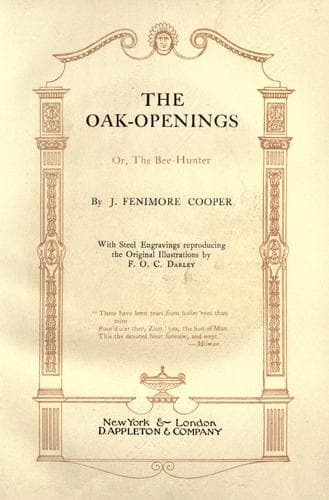
American fiction -- 19th century; Historical fiction; Indians of North America -- Fiction
“Brothers, you have been told that this weasel does not know the tribe
of which I am born. Why should you know it? Injins once were foolish.
While the pale-faces were getting one hunting-ground after another from
them, they dug up the hatchet against their own friends. They took each
other's scalps. Injin hated Injin--tribe hated tribe. I am of no tribe,
and no one can hate me for my people. You see my skin. It is red. That
is enough. I scalp, and smoke, and talk, and go on weary paths for all
Injins, and not for any tribe. I am without a tribe. Some call me the
Tribeless. It is better to bear that name, than to be called a weasel. I
have done.”
Peter had so much success by this argumentum ad hominem, that most
present fancied that the weasel would creep through some hole, and
disappear. Not so, however, with Ungque. He was a demagogue, after an
Indian fashion; and this is a class of men that ever “make capital” of
abuses, as we Americans say, in our money-getting habits. Instead of
being frightened off the ground, he arose to answer as promptly as if a
practised debater, though with an air of humility so profound, that no
one could take offence at his presumption.
“The unknown chief has answered,” he said, “I am glad. I love to hear
his words. My ears are always open when he speaks, and my mind is
stronger. I now see that it is good he should not have a tribe. He may
be a Cherokee, and then our warriors would wish him ill.” This was a
home-thrust, most artfully concealed; a Cherokee being the Indian of all
others the most hated by the chiefs present;--the Carthaginians of those
western Romans. “It is better he should not have a tribe, than be a
Cherokee. He might better be a weasel.
“Brothers, we have been told to kill ALL the pale-faces. I like that
advice. The land cannot have two owners. If a pale-face owns it, an
Injin cannot. If an Injin owns it, a pale-face cannot. But the chief
without a tribe tells us not to kill all. He tells us to kill all but
the bee-hunter and his squaw. He thinks this bee-hunter is a medicine
bee-hunter, and may do us Injins great harm. He wishes to let him go.
“Brothers, this is not my way of thinking. It is better to kill the
bee-hunter and his squaw while we can, that there may be no more such
medicine bee-hunters to frighten us Injins. If one bee-hunter can do so
much harm, what would a tribe of bee-hunters do? I do not want to see
any more. It is a dangerous thing to know how to talk with bees. It
is best that no one should have that power. I would rather never taste
honey again, than live among pale-faces that can talk with bees.
“Brothers, it is not enough that the pale-faces know so much more than
the red men, but they must get the bees to tell them where to find
honey, to find bears, to find warriors. No; let us take the scalp of the
bee-talker, and of his squaw, that there may never be such a medicine
again. I have spoken.”
Public-domain text, read in full here on John Shaqi.
Reviews
Reviews
No reviews yet
Be the first to share your thoughts on this work.
Elsewhere in the archive
Join the Discussion
Join the discussion
Sign in to leave a comment or review.
Sign InorCreate an account