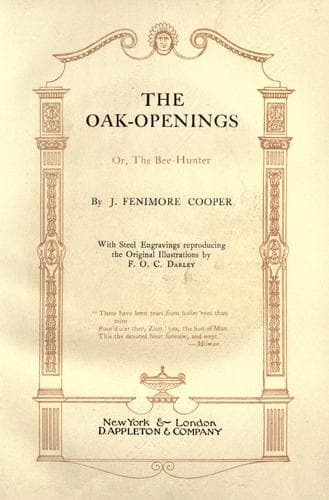
American fiction -- 19th century; Historical fiction; Indians of North America -- Fiction
“Brother, before you start on this journey, from which no traveller ever
returns, let his color be what it may, we wish to hear you speak further
about loving our enemies. This is not the Indian rule. The red men hate
their enemies, and love their friends. When they ask the Manitou to
do anything to their enemies, it is to do them harm. This is what our
fathers taught us: it is what we teach our children. Why should we love
them that hate us: why should we do good to them that do us harm? Tell
us now, or we may never hear the reason.”
“Tell you I will, Peter, and the Lord so bless my words that they may
soften your hearts, and lead you all to the truth, and to dependence on
the mediation of his blessed Son! We should do good to them that do evil
to us, because the Great Spirit has commanded us so to do. Ask your own
heart if this is not right. If they sound like words that are spoken by
any but those who have been taught by the Manitou, himself. The devils
tell us to revenge, but God commands us to forgive. It is easy to do
good to them that do good to us; but it tries the heart sorely to do
good to them that do us evil. I have spoken to you of the Son of the
Great Spirit. He came on earth, and told us with his own mouth all these
great truths. He said that next to the duty of loving the Manitou, was
the duty of loving our neighbors. No matter whether friend or enemy, it
was our duty to love them, and do them all the good we can. If there is
no venison in their wigwams, we should take the deer off our own poles,
and carry it and put on theirs. Why have I come here to tell you this?
When at home, I lived under a good roof, eat of abundance, and slept in
a soft and warm bed. You know how it is here. We do not know to-day what
we shall eat to-morrow. Our beds are hard, and our roofs are of bark. I
come, because the Son of the Manitou, he who came and lived among men,
told us to do all this. His commands to his medicine-men were, to go
forth, and tell all nations, and tribes, and colors, the truth--to
tell them to 'love them that sought to do them harm, and to do good for
evil.'”
Parson Amen pausing a moment to take breath, Ungque, who detected the
wavering of Peter's mind, and who acted far more in opposition to the
mysterious and tribeless chief than from any other motive, profited by
the occasion thus afforded to speak. Without this pause, however, the
breeding of an Indian would have prevented any interruption.
“I open my mouth to speak,” said The Weasel, in his humblest manner.
“What I say is not fit for the wise chiefs to hear. It is foolish, but
my mind tells me to say it. Does the medicine-man of the pale-faces tell
us that the Son of the Great Spirit came upon earth, and lived among
men?”
“I do; such is our belief; and the religion we believe and teach cometh
directly from his mouth.”
“Let the medicine-man tell the chiefs how long the Son of the Great
Spirit stayed on earth, and which way he went when he left it.”
Public-domain text, read in full here on John Shaqi.
Reviews
Reviews
No reviews yet
Be the first to share your thoughts on this work.
Elsewhere in the archive
Join the Discussion
Join the discussion
Sign in to leave a comment or review.
Sign InorCreate an account