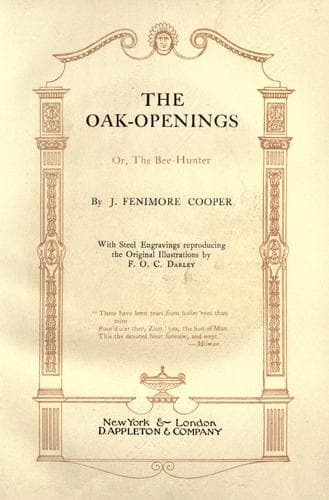
American fiction -- 19th century; Historical fiction; Indians of North America -- Fiction
Now, this question was put by Ungque through profound dissimulation. He
had heard of the death of Christ, and had obtained some such idea of
the great sacrifice as would be apt to occur to the mind of a savage.
He foresaw that the effect of the answer would be very likely to destroy
most of the influence that the missionary had just been building up, by
means of his doctrine and his prayers. Parson Amen was a man of singular
simplicity of character, but he had his misgivings touching the effect
of this reply. Still he did not scruple about giving it, or attempt in
any manner to mystify or to deceive.
“It is a humiliating and sad story, my brethren, and one that ought to
cause all heads to be bowed to the earth in shame,” he answered. “The
Son of the Great Spirit came among men; he did nothing but good; told
those who heard him how to live and how to die. In return for all this,
wicked and unbelieving men put him to death. After death his body
was taken up into Heaven--the region of departed spirits, and the
dwelling-place of his Father--where he now is, waiting for the time
when he is to return to the earth, to reward the good and to punish the
wicked. That time will surely come; nor do I believe the day to be very
distant.”
The chiefs listened to this account with grave attention. Some of them
had heard outlines of the same history before. Accounts savoring of the
Christian history had got blended with some of their own traditions,
most probably the fruits of the teachings of the earlier missionaries,
but were so confused and altered as to be scarcely susceptible of being
recognized. To most of them, however, the history of the incarnation
of the Son of God was entirely new; and it struck THEM as a most
extraordinary thing altogether that any man should have injured such
a being! It was, perhaps, singular that no one of them all doubted
the truth of the tradition itself. This they supposed to have been
transmitted with the usual care, and they received it as a fact not to
be disputed. The construction that was put on its circumstances will
best appear in the remarks that followed.
“If the pale-faces killed the Son of the Great Spirit,” said Bough of
the Oak, pointedly, “we can see why they wish to drive the red men from
their lands. Evil spirits dwell in such men, and they do nothing but
what is bad. I am glad that our great chief has told us to put the foot
on this worm and crush it, while yet the Indian foot is large enough to
do it. In a few winters they would kill us, as they killed the Spirit
that did them nothing but good!”
Public-domain text, read in full here on John Shaqi.
Reviews
Reviews
No reviews yet
Be the first to share your thoughts on this work.
Elsewhere in the archive
Join the Discussion
Join the discussion
Sign in to leave a comment or review.
Sign InorCreate an account