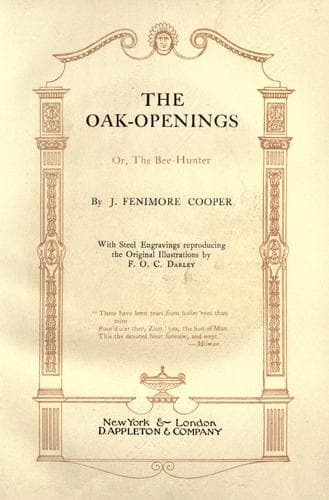
American fiction -- 19th century; Historical fiction; Indians of North America -- Fiction
There was little in common between the natural objects of that placid
and rural scene and the fell passions that were so actively at work
among the savages. The whole of the landscape was bathed in the light
of a clear, warm summer's day. These are the times when the earth truly
seems a sanctuary, in spots remote from the haunts of men, and least
exposed to his abuses. The bees hum around the flowers, the birds carol
on the boughs and from amid their leafy arbors, while even the leaping
and shining waters appear to be instinct with the life that extols the
glory of God.
As for the family near the palisaded hut, happiness had not, for many
a month, been so seated among them, as on this very occasion. Dorothy
sympathized truly in the feelings of the youthful and charming bride,
while Gershom had many of the kind and affectionate wishes of a brother
in her behalf. The last was in his best attire, as indeed were the
females, who were neatly though modestly clad, and Gershom had that air
of decent repose and of quiet enjoyment, which is so common of a Sabbath
with the men of his class, among the people from whom he sprung. The
fears lately excited were momentarily forgotten. Everything around them
wore an air so placid; the vault above them was so profoundly tranquil;
the light of day was so soft and yet so bright; the Openings seemed so
rural and so much like pictures of civilization, that apprehension had
been entirely forgotten in present enjoyment. Such was the moment when
Peter suddenly stood before le Bourdon and Margery, as the young couple
sat beneath the shade of the oaks, near the spring. One instant the
Indian regarded this picture of young wedded life with a gleam of
pleasure on his dark face; then he announced his presence by speaking.
“Can't sit here lookin' at young squaw,” said this literal being.
“Get up, and put thing in canoe. Time come to go on path dat lead to
pale-face country.”
“What has happened, Peter?” demanded the bee-hunter, springing to his
feet. “You come like a runner rushing in with his bad tidings. Has
anything happened to give an alarm?”
“Up, and off, tell you. No use talkin' now. Put all he can in canoe,
and paddle away fast as can.” There was no mistaking Peter's manner. The
bee-hunter saw the uselessness of questioning such a man, at a time like
that, and he called to Gershom to join him.
“Here is the chief, to warn us to move,” said the bee-hunter,
endeavoring to appear calm, in order that he might not needlessly alarm
the females, “and what he advises, we had better do. I know there is
danger, by what has fallen from Pigeonswing as well as from himself; so
let us lose no time, but stow the canoes, and do as he tells us.”
Public-domain text, read in full here on John Shaqi.
Reviews
Reviews
No reviews yet
Be the first to share your thoughts on this work.
Elsewhere in the archive
Join the Discussion
Join the discussion
Sign in to leave a comment or review.
Sign InorCreate an account