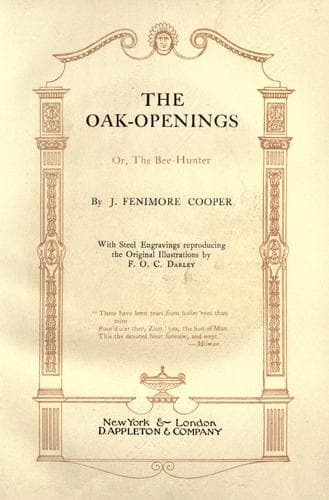
American fiction -- 19th century; Historical fiction; Indians of North America -- Fiction
As Gershom assented, it was not two minutes ere all were at work. For
several days, each canoe had been furnished with provisions for a hasty
flight. It remained only to add such of the effects as were too valuable
and necessary to be abandoned, and which had not been previously exposed
without the palisades. For half an hour le Bourdon and Gershom worked
as for life. No questions were asked, nor was a single moment lost, in
a desire to learn more. The manner in which Peter bore himself satisfied
Boden that the emergency was pressing, and it is seldom that more was
done by so few hands in so short a period. Fortunately, the previous
preparation greatly aided the present object, and nearly everything of
any value was placed in the canoes within the brief space mentioned. It
then became necessary to decide concerning the condition in which Castle
Meal was to be left. Peter advised closing every aperture, shutting
the gate, and leaving the dog within. There is no doubt that these
expedients prevented the parties falling early into the hands of their
enemies; for the time lost by the savages in making their approaches to
the hut was very precious to the fugitives.
Just as the canoes were loaded, Pigeonswing came in. He announced that
the whole band was in motion, and might be expected to reach the grove
in ten minutes. Placing an arm around the slender waist of Margery, le
Bourdon almost carried her to his own canoe, Gershom soon had Dorothy in
his little bark, while Peter entered that to the ownership of which he
may be said to have justly succeeded by the deaths of the corporal and
the missionary. Pigeonswing remained behind, in order to act as a scout,
having first communicated to Peter the course the last ought to steer.
Before the Chippewa plunged into the cover in which it was his intention
to conceal himself, he made a sign that the band was already in sight.
The heart of le Bourdon sunk within him, when he learned how near were
the enemy. To him, escape seemed impossible; and he now regretted having
abandoned the defences of his late residence. The river was sluggish for
more than a mile at that spot, and then occurred a rift, which could
not be passed without partly unloading the canoes, and where there must
necessarily be a detention of more than an hour. Thus, it was scarcely
possible for canoes descending that stream to escape from so large a
band of pursuers. The sinuosities, themselves, would enable the last
to gain fifty points ahead of them, where ambushes, or even open
resistance, must place them altogether at the mercy of the savages.
Public-domain text, read in full here on John Shaqi.
Reviews
Reviews
No reviews yet
Be the first to share your thoughts on this work.
Elsewhere in the archive
Join the Discussion
Join the discussion
Sign in to leave a comment or review.
Sign InorCreate an account