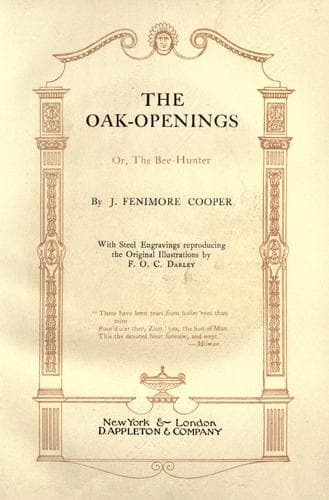
American fiction -- 19th century; Historical fiction; Indians of North America -- Fiction
beings; that of attributing to themselves, and their own prowess, a
success that had been gained by others.
The bee-hunter and his friend now set themselves at work to provide
a reception for the insects, the return of which might shortly be
expected. The former lighted a fire, being always provided with the
means, while Gershom brought dry wood. In less than five minutes a
bright blaze was gleaming upward, and when the bees returned, as most
of them soon did, they found this new enemy intrenched, as it might be,
behind walls of flame. Thousands of the little creatures perished by
means of this new invention of man, and the rest soon after were led
away by their chiefs to seek some new deposit for the fruits of their
industry.
CHAPTER IV.
The sad butterfly,
Waving his lackered wings, darts quickly on,
And, by his free flight, counsels us to speed
For better lodgings, and a scene more sweet,
Than these dear borders offer us to-night.
SIMMS.
It was noon before Ben and Gershom dared to commence the process of
cutting and splitting the tree, in order to obtain the honey. Until
then, the bees lingered around their fallen hive, and it would have been
dangerous to venture beyond the smoke and heat, in order to accomplish
the task. It is true, le Bourdon possessed several secrets, of more or
less virtue, to drive off the bees when disposed to assault him, but
no one that was as certain as a good fire, backed by a dense column of
vapor. Various plants are thought to be so offensive to the insects,
that they avoid even their odor; and the bee-hunter had faith in one or
two of them; but none of the right sort happened now to be near, and he
was obliged to trust, first to a powerful heat, and next to the vapor of
damp wood.
As there were axes, and wedges, and a beetle in the canoe, and Gershom
was as expert with these implements as a master of fencing is with his
foil, to say nothing of the skill of le Bourdon, the tree was soon
laid open, and its ample stores of sweets exposed. In the course of the
afternoon the honey was deposited in kegs, the kegs were transferred to
the canoe, and the whole deposited in the chiente. The day had been one
of toil, and when our two bordermen sat down near the spring, to take
their evening meal, each felt glad that his work was done.
“I believe this must be the last hive I line, this summer,” said le
Bourdon, while eating his supper. “My luck has been good so far, but
in troublesome times one had better not be too far from home. I am
surprised, Waring, that you have ventured so far from your family, while
the tidings are so gloomy.”
Public-domain text, read in full here on John Shaqi.
Reviews
Reviews
No reviews yet
Be the first to share your thoughts on this work.
Join the Discussion
Join the discussion
Sign in to leave a comment or review.
Sign InorCreate an account