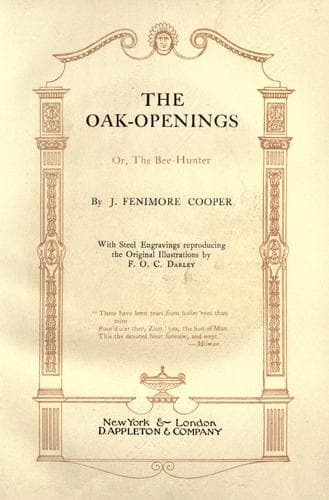
American fiction -- 19th century; Historical fiction; Indians of North America -- Fiction
The bee-hunter did not abandon his station without regret. He had chosen
a most agreeable site for his chiente, consulting air, shade, water,
verdure, and groves, as well as the chances of obtaining honey. In his
regular pursuit he had been unusually fortunate; and the little pile of
kegs in the centre of his canoe was certainly a grateful sight to his
eyes. The honey gathered this season, moreover, had proved to be of an
unusually delicious flavor, affording the promise of high prices and
ready sales. Still, the bee-hunter left the place with profound regret.
He loved his calling; he loved solitude to a morbid degree, perhaps; and
he loved the gentle excitement that naturally attended his “bee-lining,”
his discoveries, and his gains. Of all the pursuits that are more or
less dependent on the chances of the hunt and the field, that of
the bee-hunter is of the most quiet and placid enjoyment. He has the
stirring motives of uncertainty and doubt, without the disturbing
qualities of bustle and fatigue; and, while his exercise is sufficient
for health, and for the pleasures of the open air, it is seldom of a
nature to weary or unnerve. Then the study of the little animal that
is to be watched, and, if the reader will, plundered, is not without
a charm for those who delight in looking into the wonderful arcana of
nature. So great was the interest that le Bourdon sometimes felt in his
little companions, that, on three several occasions that very summer,
he had spared hives after having found them, because he had ascertained
that they were composed of young bees, and had not yet got sufficiently
colonized to render a new swarming more than a passing accident. With
all this kindness of feeling toward his victims, Boden had nothing of
the transcendental folly that usually accompanies the sentimentalism of
the exaggerated, but his feelings and impulses were simple and direct,
though so often gentle and humane. He knew that the bee, like all the
other inferior animals of creation, was placed at the disposition
of man, and did not scruple to profit by the power thus beneficently
bestowed, though he exercised it gently, and with a proper
discrimination between its use and its abuse.
Neither of the men toiled much, as the canoe floated down the stream.
Very slight impulses served to give their buoyant craft a reasonably
swift motion, and the current itself was a material assistant. These
circumstances gave an opportunity for conversation, as the canoe glided
onward.
“A'ter all,” suddenly exclaimed Waring, who had been examining the pile
of kegs for some time in silence--“a'ter all, Bourdon, your trade is an
oncommon one! A most extr'ornary and oncommon callin'!”
“More so, think you, Gershom, than swallowing whiskey, morning, noon,
and night?” answered the bee-hunter, with a quiet smile.
Public-domain text, read in full here on John Shaqi.
Reviews
Reviews
No reviews yet
Be the first to share your thoughts on this work.
Join the Discussion
Join the discussion
Sign in to leave a comment or review.
Sign InorCreate an account