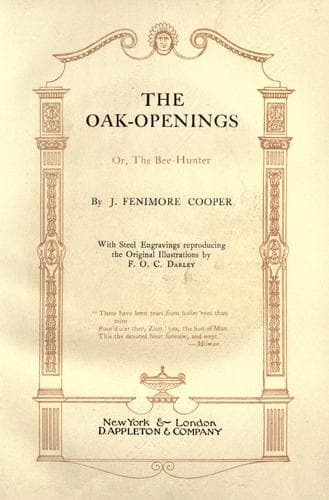
American fiction -- 19th century; Historical fiction; Indians of North America -- Fiction
The bee-hunter was astonished at the immovable calmness with which
Pigeonswing still stood to his tree, awaiting the approach of the
sentinel. In a few moments the latter was at his side. At first the
Pottawattamie did not perceive that the prisoner was unbound. He threw
him into shadow by his own person, and it required a close look to note
the circumstance. Boden was too far from the spot to see all the minor
movements of the parties, but there was soon a struggle that could
not be mistaken. As the Pottawattamie was examining the prisoner, an
exclamation that escaped him betrayed the sudden consciousness that the
Chippewa was unbound. The sound was no sooner uttered than Pigeonswing
made a grasp at the sentinel's knife, which however he did not obtain,
when the two closed and fell, rolling down the declivity into the
darkness. When the Pottawattamie seized the Chippewa, he uttered a
yell, which instantly brought every man of his party to his feet. As the
savages now united in the whoops, and the dogs began to bark wildly, an
infernal clamor was made.
At first, le Bourdon did not know how to act. He greatly feared the
dogs, and could not but think of Margery, and the probable consequences,
should those sagacious animals follow him across the marsh. But he did
not like the idea of abandoning Pigeonswing, when a single blow of his
arm, or a kick of his foot, might be the cause of his escape. While
deliberating in painful uncertainty, the sounds of the struggle ceased,
and he saw the sentinel rising again into the light, limping like one
who had suffered by a fall. Presently he heard a footstep near him, and,
calling in a low voice, he was immediately joined by Pigeonswing. Before
the bee-hunter was aware of his intention, the Chippewa seized his
rifle, and levelling at the sentinel, who still stood on the brow of the
hill, drawn in all his savage outlines distinctly in the light of
the flames, he fired. The cry, the leap into the air, and the fall,
announced the unerring character of the aim. In coming to the earth,
the wounded man fell over the brow of the sharp acclivity, and was heard
rolling toward its base.
Public-domain text, read in full here on John Shaqi.
Reviews
Reviews
No reviews yet
Be the first to share your thoughts on this work.
Elsewhere in the archive
Join the Discussion
Join the discussion
Sign in to leave a comment or review.
Sign InorCreate an account