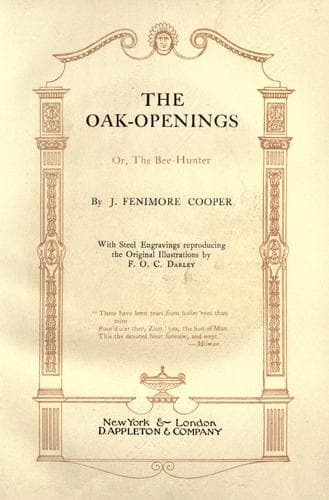
American fiction -- 19th century; Historical fiction; Indians of North America -- Fiction
Le Bourdon felt the importance of now improving the precious moments,
and was in the act of urging his companion to follow, when the latter
passed an arm around his body, whipped his knife from the girdle and
sheath, and dropping the rifle into his friend's arms, bounded away in
the darkness, taking the direction of his fallen enemy. There was no
mistaking all this; Chippewa, led by his own peculiar sense of honor,
risking everything to obtain the usual trophy of victory. By this time,
a dozen of the savages stood on the brow of the hill, seemingly at a
loss to understand what had become of the combatants. Perceiving
this, the bee-hunter profited by the delay and reloaded his rifle. As
everything passed almost as swiftly as the electric spark is known
to travel, it was but a moment after the Pottawattamie fell ere his
conqueror was through with his bloody task. Just as le Bourdon threw his
rifle up into the hollow of his arm, he was rejoined by his red
friend, who bore the reeking scalp of the sentinel at his belt; though
fortunately the bee-hunter did not see it on account of the obscurity,
else might he not have been so willing to continue to act with so
ruthless an ally.
Further stay was out of the question; for the Indians were now collected
in a body on the brow of the hill, where the chief was rapidly issuing
his orders. In a minute the band dispersed, every man bounding into the
darkness, as if aware of the danger of remaining within the influence of
the bright light thrown from the fire. Then came such a clamor from
the dogs, as left no doubt in the mind of the bee-hunter that they had
scented and found the remains of the fallen man. A fierce yell came from
the same spot, the proof that some of the savages had already discovered
the body; and le Bourdon told his companion to follow, taking his way
across the marsh as fast as he could overcome the difficulties of the
path.
It has already been intimated that it was not easy, if indeed it were
possible, to cross that piece of low wet land in a direct line. There
was tolerably firm ground on it, but it lay in an irregular form, its
presence being generally to be noted by the growth of trees. Le
Bourdon had been very careful in taking his landmarks, foreseeing the
probability of a hasty retreat, and he had no difficulty for some time
in keeping in the right direction. But the dogs soon left the dead
body, and came bounding across the marsh, disregarding its difficulties;
though their plunges and yells soon made it apparent that even they did
not escape altogether with dry feet. As for the savages, they poured
down the declivity in a stream, taking the dogs as their guides;
and safe ones they might well be accounted, so far as the SCENT was
concerned, though they did not happen to be particularly well acquainted
with all the difficulties of the path.
Public-domain text, read in full here on John Shaqi.
Reviews
Reviews
No reviews yet
Be the first to share your thoughts on this work.
Elsewhere in the archive
Join the Discussion
Join the discussion
Sign in to leave a comment or review.
Sign InorCreate an account