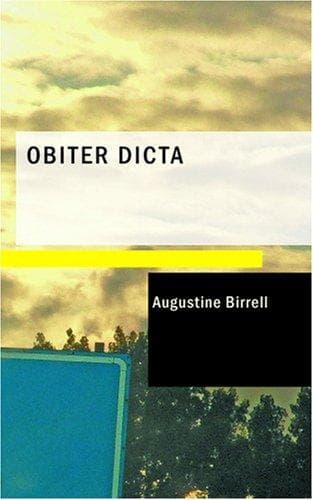
English literature -- History and criticism; Historiography; Literature
What is it to be a great actor? I say a great actor, because (I am sure)
no amateur ever fancied himself a small one. Is it not always to have
the best parts in the best plays; to be the central figure of every
group; to feel that attention is arrested the moment you come on the
stage; and (more exquisite satisfaction still) to be aware that it
is relaxed when you go off; to have silence secured for your smallest
utterances; to know that the highest dramatic talent has been exercised
to invent situations for the very purpose of giving effect to _your_
words and dignity to _your_ actions; to quell all opposition by the
majesty of your bearing or the brilliancy of your wit; and finally,
either to triumph over disaster, or if you be cast in tragedy, happier
still, to die upon the stage, supremely pitied and honestly mourned
for at least a minute? And then, from first to last, applause loud and
long--not postponed, not even delayed, but following immediately after.
For a piece of diseased egotism--that is, for a man--what a lot is this!
How pointed, how poignant the contrast between a hero on the boards
and a hero in the streets! In the world's theatre the man who is really
playing the leading part--did we but know it--is too often, in the
general estimate, accounted but one of the supernumeraries, a figure
in dingy attire, who might well be spared, and who may consider himself
well paid with a pound a week. _His_ utterances procure no silence.
He has to pronounce them as best he may, whilst the gallery sucks its
orange, the pit pares its nails, the boxes babble, and the stalls yawn.
Amidst, these pleasant distractions he is lucky if he is heard at all;
and perhaps the best thing that can befall him is for somebody to think
him worth the trouble of a hiss. As for applause, it may chance with
such men, if they live long enough, as it has to the great ones who have
preceded them, in their old age,
'When they are frozen up within, and quite
The phantom of themselves,
To hear the world applaud the hollow ghost
Which blamed the living man.'
The great actor may sink to sleep, soothed by the memory of the tears
or laughter he has evoked, and wake to find the day far advanced, whose
close is to witness the repetition of his triumph; but the great man
will lie tossing and turning as he reflects on the seemingly unequal war
he is waging with stupidity and prejudice, and be tempted to exclaim,
as Milton tells us he was, with the sad prophet Jeremy: 'Woe is me, my
mother, that thou hast borne me, a man of strife and contention!'
The upshot of all this is, that it is a pleasanter thing to represent
greatness than to be great.
But the actor's calling is not only pleasant in itself--it gives
pleasure to others. In this respect, how favourably it contrasts with
the three learned professions!
Public-domain text, read in full here on John Shaqi.
Reviews
Reviews
No reviews yet
Be the first to share your thoughts on this work.
Join the Discussion
Join the discussion
Sign in to leave a comment or review.
Sign InorCreate an account