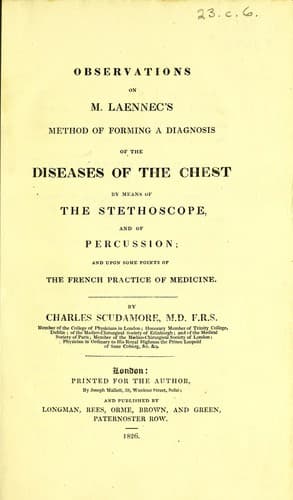
Observations on M. Laennec's method of forming a diagnosis of the diseases of the chest by means of the stethoscope, and of percussion; and upon some points of the French practice of medicineScudamore, Charles
Science
Observations on M. Laennec's method of forming a diagnosis of the diseases of the chest by means of the stethoscope, and of percussion; and upon some points of the French practice of medicine
Scudamore, Charles
Chest -- Diseases -- Diagnosis; Laennec, R. T. H. (René Théophile Hyacinthe), 1781-1826
Gout never assails the husbandman who unites temperance with his
labours; but he is not exempted from rheumatism in any of its forms.
Gout is the disorder of peculiar constitutions, and of the adult
age; but rheumatism occurs at every period of life, and to all
constitutions.
On the assumption that gout is a _gastro-enterite_, with a
developement of irritation in the joints, purgative medicines are
prohibited, and the free application of leeches to the affected parts
is recommended as the chief curative treatment.
I admit that in some circumstances of the gouty paroxysm, the mucous
digestive membrane is affected with inflammatory irritation,
requiring suitable and peculiar treatment; but, as a general
principle of practice, I confidently advocate the use of alteratives
and purgatives, and, with only occasional exceptions, disapprove
of the employment of leeches as a remedy for the local part of the
disease.
As in theory, so in practice, I believe that M. Broussais considers
that rheumatism is to be viewed in the same light as the gout.
M. Laennec employs general bleeding in acute rheumatism; leeches in
the chronic; and tartar emetic in both forms of the disorder.
An analytical examination of the points of doctrine and practice,
which I have here briefly discussed, would lead me far beyond the
limits which I have intended to observe in this Essay; but I could
not overlook the most interesting novelty which has, for the last
five years, engaged the French school of medicine.
It is still a custom amongst the French physicians to employ
_tisanes_, which are decoctions or infusions of roots, herbs,
flowers, or grains, as medicinal remedies on which they seem to place
considerable reliance. The “_formulaire pratique des Hôpitaux civils
de Paris_” contains nearly ninety prescriptions of different kinds
of tisane. With us, the Lisbon diet drink, or the simple decoction
of sarsaparilla, is the only medicine which we direct to be taken
in quantity as a drink. But even sarsaparilla is given with more
advantage, in a state of concentration, by using the cortical part of
the root, exclusively, in which the whole virtue seems to reside.
I object to the general principle of using medicine in a state of
large dilution. It is true that the French do not prescribe active
substances in this form; but their fondness for these feeble agents,
tends to establish inefficient and almost insignificant practice.
Diluent drinks are useful adjuncts to medicine; but I should think
that a very limited number of tisanes would comprise all that can be
considered either as useful or agreeable.
Public-domain text, read in full here on John Shaqi.
Reviews
Reviews
No reviews yet
Be the first to share your thoughts on this work.
Join the Discussion
Join the discussion
Sign in to leave a comment or review.
Sign InorCreate an account