Observations on Mount Vesuvius, Mount Etna, and Other VolcanosHamilton, William, Sir
Science
Observations on Mount Vesuvius, Mount Etna, and Other Volcanos
Hamilton, William, Sir
Etna, Mount (Italy) -- Early works to 1800; Vesuvius (Italy) -- Early works to 1800; Volcanoes -- Italy -- Early works to 1800
Produced by Bryan Ness, Stephen H. Sentoff, Alicia Williams
and the Online Distributed Proofreading Team at
https://www.pgdp.net (This book was produced from scanned
images of public domain material from the Google Print
project.)
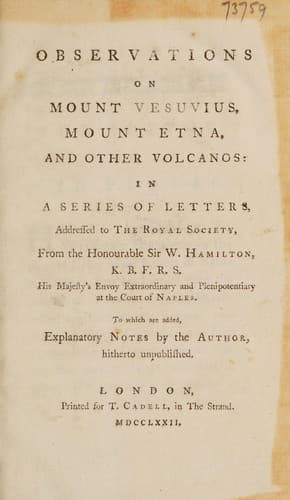
OBSERVATIONS
ON
MOUNT VESUVIUS,
MOUNT ETNA,
AND OTHER VOLCANOS:
IN
A SERIES OF LETTERS,
Addressed to THE ROYAL SOCIETY,
From the Honourable Sir W. HAMILTON,
K.B. F.R.S.
His Majesty's Envoy Extraordinary and Plenipotentiary
at the Court of NAPLES.
To which are added,
Explanatory NOTES by the AUTHOR,
hitherto unpublished.
A NEW EDITION.
LONDON,
Printed for T. CADELL, in the Strand.
M DCC LXXIV.
THE EDITOR
TO
THE PUBLIC.
Having mentioned to Sir WILLIAM HAMILTON the general Desire of all
Lovers of Natural History, that his Letters upon the Subject of VOLCANOS
should be collected together in one Volume, particularly for the
Convenience of such as may have an Opportunity of visiting the curious
Spots described in them: He was not only pleased to approve of my
having undertaken this Publication, but has likewise favoured with the
additional explanatory Notes and Drawings,
The PUBLIC's most obliged,
and devoted
humble Servant,
T. CADELL.
May 30, 1772.
OBSERVATIONS
ON
MOUNT VESUVIUS, &c.
LETTER I.
To the Right Honourable the Earl of MORTON, President of the Royal
Society.
Naples, June 10, 1766.
My LORD,
As I have attended particularly to the various changes of Mount
Vesuvius, from the 17th of November 1764, the day of my arrival at this
capital; I flatter myself, that my observations will not be unacceptable
to your Lordship, especially as this Volcano has lately made a very
considerable eruption. I shall confine myself merely to the many
extraordinary appearances that have come under my own inspection, and
leave their explanation to the more learned in Natural Philosophy.
During the first twelvemonth of my being here, I did not perceive any
remarkable alteration in the mountain; but I observed, the smoke from
the Volcano was much more considerable in bad weather than when it was
fair[1]; and I often heard (even at Naples, six miles from Vesuvius) in
bad weather, the inward explosions of the mountain. When I have been at
the top of Mount Vesuvius in fair weather, I have sometimes found so
little smoke, that I have been able to see far down the mouth of the
Volcano; the sides of which were incrusted with salts and mineral of
various colors, white, green, deep and pale yellow. The smoke that
issued from the mouth of the Volcano in bad weather was white, very
moist, and not near so offensive as the sulphureous steams from various
cracks on the sides of the mountain.
Public-domain text, read in full here on John Shaqi.
Reviews
Reviews
No reviews yet
Be the first to share your thoughts on this work.
Join the Discussion
Join the discussion
Sign in to leave a comment or review.
Sign InorCreate an account