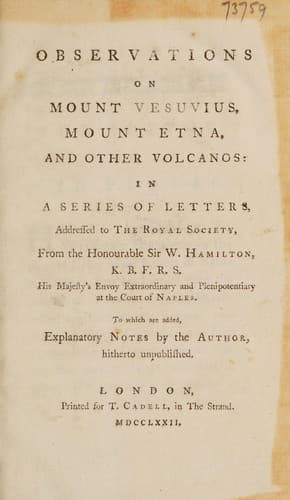
Observations on Mount Vesuvius, Mount Etna, and Other Volcanos — John Shaqi
Observations on Mount Vesuvius, Mount Etna, and Other VolcanosHamilton, William, Sir
Science
Observations on Mount Vesuvius, Mount Etna, and Other Volcanos
Hamilton, William, Sir
Etna, Mount (Italy) -- Early works to 1800; Vesuvius (Italy) -- Early works to 1800; Volcanoes -- Italy -- Early works to 1800
After having examined with much attention the operations of Mount
Vesuvius, during the five years that I have had the honour of residing
as his Majesty's Minister at this Court, and after having carefully
remarked the nature of the soil for fifteen miles round this capital; I
am, in my own mind, well convinced that the whole of it has been formed
by explosion. Many of the craters, from whence this matter has issued,
are still visible; such as the Solfaterra near Puzzole, the lake of
Agnano, and near this lake a mountain composed of burnt matter, that has
a very large crater surrounded with a wall, to inclose the wild boars
and deer, that are kept there for the diversion of his Sicilian Majesty;
it is called Astruni: the Monte Nuovo, thrown up from the bottom of the
Lucrine lake[17] in the year 1538, which has likewise its crater; and
the lake of Averno. The islands of Nisida and Procida are entirely
composed of burnt matter; the island of Ischia is likewise composed of
lava, pumice, and burnt matter; and there are in that island several
visible craters, from one of which, no longer ago than the year 1303,
there issued a lava, which ran into the sea, and is still in the same
barren state as the modern lavas of Vesuvius. After having, I say, been
accustomed to these observations, I was well prepared to visit the most
ancient, and perhaps the most considerable, Volcano that exists; and I
had the satisfaction of being thoroughly convinced there, of the
formation of very considerable mountains by meer explosion, having seen
many such on the sides of Etna, as will be related hereafter.
On the 24th of June last, in the afternoon, I left Catania, a town
situated at the foot of Mount Etna, or, as it is now called,
Mon-Gibello, in company with Lord Fortrose and the Canonico Recupero, an
ingenious priest of Catania, who is the only person there that is
acquainted with the mountain: he is actually employed in writing its
natural history; but, I fear, will not be able to compass so great and
useful an undertaking, for want of proper encouragement.
Public-domain text, read in full here on John Shaqi.
Reviews
Reviews
No reviews yet
Be the first to share your thoughts on this work.
Join the Discussion
Join the discussion
Sign in to leave a comment or review.
Sign InorCreate an account