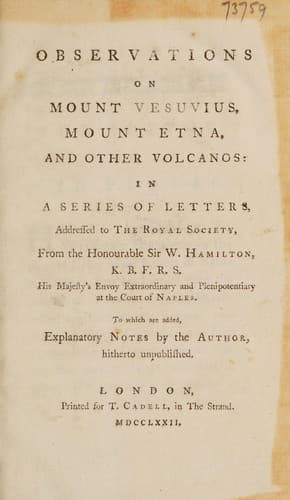
Observations on Mount Vesuvius, Mount Etna, and Other VolcanosHamilton, William, Sir
Science
Observations on Mount Vesuvius, Mount Etna, and Other Volcanos
Hamilton, William, Sir
Etna, Mount (Italy) -- Early works to 1800; Vesuvius (Italy) -- Early works to 1800; Volcanoes -- Italy -- Early works to 1800
After having passed at least three hours on the crater, we descended,
and went to a rising ground, about a mile distant from the upper
mountain we had just left, and saw there some remains of the foundation
of an ancient building; it is of brick, and seems to have been
ornamented with white marble, many fragments of which are scattered
about. It is called the Philosopher's Tower, and is said to have been
inhabited by Empedocles. As the ancients used to sacrifice to the
celestial gods on the top of Etna[23], it may very well be the ruin of a
temple that served for that purpose. From hence we went a little further
over the inclined plain abovementioned, and saw the evident marks of a
dreadful torrent of hot water, that came out of the great crater at the
time of an eruption of lava in the year 1755, and upon which phaenomenon
the Canonico Recupero, our guide, has published a dissertation. Luckily
this torrent did not take its course over the inhabited parts of the
mountain; as a like accident on Mount Vesuvius in 1631 swept away some
towns and villages in its neighbourhood, with thousands of their
inhabitants. The common received opinion is, that these eruptions of
water proceed from the Volcanos having a communication with the sea; but
I rather believe them to proceed merely from depositions of rain water
in some of the inward cavities of them. We likewise saw from hence the
whole course of ancient lava, the most considerable as to its extent of
any known here; it ran into the sea near Taormina, which is not less
than thirty miles from the crater whence it issued, and is in many parts
fifteen miles in breadth. As the lavas of Etna are very commonly fifteen
and twenty miles in length, six or seven in breadth, and fifty feet or
more in depth; you may judge, Sir, of the prodigious quantities of
matter emitted in a great eruption of this mountain, and of the vast
cavities there must necessarily be within its bowels. The most extensive
lavas of Vesuvius do not exceed seven miles in length. The operations of
nature on the one mountain and the other are certainly the same; but on
Mount Etna, all are upon a great scale. As to the nature and quality of
their lavas, they are much the same; but I think those of Etna rather
blacker, and in general more porous, than those of Vesuvius. In the
parts of Etna that we went over, I saw no stratas of pumice stones,
which are frequent near Vesuvius, and cover the ancient city of Pompeii;
but our guide told us, that there are such in other parts of the
mountain. I saw some stratas of what is called here _tufa_; it is the
same that covers Herculaneum, and that composes most of the high grounds
about Naples; it is, upon examination, a mixture of small pumice stones,
ashes, and fragments of lava, which is by time hardened into a sort of
stone[24]. In short, I found, with respect to the matter erupted,
nothing on Mount Etna that Vesuvius does not produce; and there
Public-domain text, read in full here on John Shaqi.
Reviews
Reviews
No reviews yet
Be the first to share your thoughts on this work.
Join the Discussion
Join the discussion
Sign in to leave a comment or review.
Sign InorCreate an account