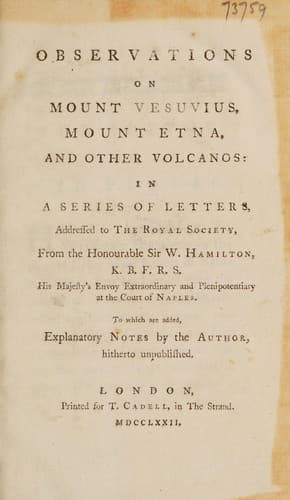
Observations on Mount Vesuvius, Mount Etna, and Other VolcanosHamilton, William, Sir
Science
Observations on Mount Vesuvius, Mount Etna, and Other Volcanos
Hamilton, William, Sir
Etna, Mount (Italy) -- Early works to 1800; Vesuvius (Italy) -- Early works to 1800; Volcanoes -- Italy -- Early works to 1800
Nature, though varied, is certainly in general uniform in her
operations; and I cannot conceive that two such considerable Volcanos as
Etna and Vesuvius should have been formed otherwise than every other
considerable Volcano of the known world. I do not wonder that so little
progress has been made in the improvement of natural history, and
particularly in that branch of it which regards the theory of earth;
Nature acts slowly, it is difficult to catch her in the fact. Those who
have made this subject their study have, without scruple, undertaken at
once to write the natural history of a whole province, or of an entire
continent; not reflecting, that the longest life of man scarcely
affords him time to give a perfect one of the smallest insect.
I am sensible of what I undertake in giving you, Sir, even a very
imperfect account of the nature of the soil of a little more than twenty
miles round Naples: yet I flatter myself that my remarks, such as they
are, may be of some use to any one hereafter, who may have leisure and
inclination to follow them up. The kingdom of the Two Sicilies offers
certainly the fairest field for observations of this kind, of any in the
whole world; here are Volcanos existing in their full force, some on
their decline, and others totally extinct.
To begin with some degree of order, which is really difficult in the
variety of matter that occurs to my mind, I will first mention the basis
on which I found all my conjectures. It is the nature of the soil that
covers the antient towns of Herculaneum and Pompeii, and the interior
and exterior form of the new mountain, near Puzzole, with the sort of
materials of which it is composed. It cannot be denied, that Herculaneum
and Pompeii stood once above ground; though now, the former is in no
part less than seventy feet, and in some parts one hundred and twelve
feet, below the present surface of the earth; and the latter is buried
ten or twelve feet deep, more or less. As we know from the very accurate
account given by Pliny the younger to Tacitus, and from the accounts of
other contemporary authors, that these towns were buried by an eruption
of Mount Vesuvius in the time of Titus; it must be allowed, that
whatever matter lies between these cities and the present surface of the
earth over them, must have been produced since the year 79 of the
Christian aera, the date of that formidable eruption.
Public-domain text, read in full here on John Shaqi.
Reviews
Reviews
No reviews yet
Be the first to share your thoughts on this work.
Join the Discussion
Join the discussion
Sign in to leave a comment or review.
Sign InorCreate an account