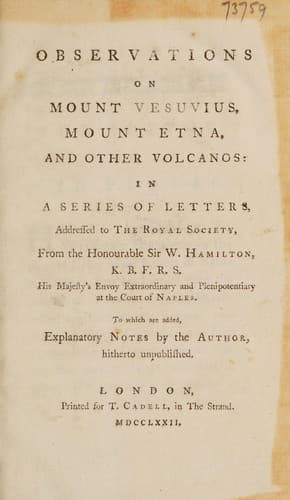
Observations on Mount Vesuvius, Mount Etna, and Other Volcanos — John Shaqi
Observations on Mount Vesuvius, Mount Etna, and Other VolcanosHamilton, William, Sir
Science
Observations on Mount Vesuvius, Mount Etna, and Other Volcanos
Hamilton, William, Sir
Etna, Mount (Italy) -- Early works to 1800; Vesuvius (Italy) -- Early works to 1800; Volcanoes -- Italy -- Early works to 1800
On Good Friday, the 28th of March, at 7 o'clock at night, the lava began
to boil over the mouth of the Volcano, at first in one stream; and soon
after, dividing itself into two, it took its course towards Portici. It
was preceded by a violent explosion, which caused a partial earthquake
in the neighbourhood of the mountain; and a shower of red hot stones and
cinders were thrown up to a considerable height. Immediately upon sight
of the lava, I left Naples, with a party of my countrymen, whom I found
as impatient as myself to satisfy their curiosity in examining so
curious an operation of nature. I passed the whole night upon the
mountain; and observed that, though the red hot stones were thrown up in
much greater number and to a more considerable height than before the
appearance of the lava, yet the report was much less considerable than
some days before the eruption. The lava ran near a mile in an hour's
time, when the two branches joined in a hollow on the side of the
mountain, without proceeding farther. I approached the mouth of the
Volcano, as near as I could with prudence; the lava had the appearance
of a river of red hot and liquid metal, such as we see in the
glass-houses, on which were large floating cinders, half lighted, and
rolling one over another with great precipitation down the side of the
mountain, forming a most beautiful and uncommon cascade; the color of
the fire was much paler and more bright the first night than the
subsequent nights, when it became of a deep red, probably owing to its
having been more impregnated with sulphur at first than afterwards. In
the day-time, unless you are quite close, the lava has no appearance of
fire; but a thick white smoke marks its course.
The 29th, the mountain was very quiet, and the lava did not continue.
The 30th, it began to flow again in the same direction, whilst the mouth
of the Volcano threw up every minute a girandole of red hot stones, to
an immense height. The 31st, I passed the night upon the mountain: the
lava was not so considerable as the first night; but the red hot stones
were perfectly transparent, some of which, I dare say of a ton weight,
mounted at least two hundred feet perpendicular, and fell in, or near,
the mouth of a little mountain, that was now formed by the quantity of
ashes and stones, within the great mouth of the Volcano, and which made
the approach much safer than it had been some days before, when the
mouth was near half a mile in circumference, and the stones took every
direction. Mr. Hervey, brother to the Earl of Bristol, was very much
wounded in the arm some days before the eruption, having approached too
near; and two English gentlemen with him were also hurt. It is
impossible to describe the beautiful appearance of these girandoles of
red hot stones, far surpassing the most astonishing artificial
fire-work.
Public-domain text, read in full here on John Shaqi.
Reviews
Reviews
No reviews yet
Be the first to share your thoughts on this work.
Join the Discussion
Join the discussion
Sign in to leave a comment or review.
Sign InorCreate an account