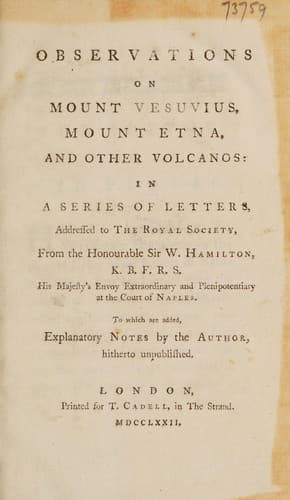
Observations on Mount Vesuvius, Mount Etna, and Other VolcanosHamilton, William, Sir
Science
Observations on Mount Vesuvius, Mount Etna, and Other Volcanos
Hamilton, William, Sir
Etna, Mount (Italy) -- Early works to 1800; Vesuvius (Italy) -- Early works to 1800; Volcanoes -- Italy -- Early works to 1800
The lava, after having run pure for about a hundred yards, began to
collect cinders, stones, &c.; and a scum was formed on its surface,
which in the day-time had the appearance of the river Thames, as I have
seen it after a hard frost and great fall of snow, when beginning to
thaw, carrying down vast masses of snow and ice. In two places the
liquid lava totally disappeared, and ran in a subterraneous passage for
some paces; then came out again pure, having left the scum behind. In
this manner it advanced to the cultivated parts of the mountain; and I
saw it, the same night of the 12th, unmercifully destroy a poor man's
vineyard, and surround his cottage, notwithstanding the opposition of
many images of St. Januarius, that were placed upon the cottage, and
tied to almost every vine. The lava, at the farthest extremity from its
source, did not appear liquid, but like a heap of red hot coals,
forming a wall in some places ten or twelve feet high, which rolling
from the top soon formed another wall, and so on, advancing slowly, not
more than about thirty feet in an hour[4].
The mouth of the Volcano has not thrown up any large stones since the
second eruption of lava on the 10th of April; but has thrown up
quantities of small ashes and pumice stones, that have greatly damaged
the neighbouring vineyards. I have been several times at the mountain
since the 12th; but, as the eruption was in its greatest vigour at that
time, I have ventured to dwell on, and I fear tire your Lordship with,
the observations of that day.
In my last visit to Mount Vesuvius, the 3d of June, I still found that
the lava continued; but the rivers were become rivulets, and had lost
much of their rapidity. The quantity of matter thrown out by this
eruption is greater than that of the last in the year 1760; but the
damage to the cultivated lands is not so considerable, owing to its
having spread itself much more, and its source being at least three
miles higher up. This eruption seems now to have exhausted itself; and I
expect in a few days to see Vesuvius restored to its former
tranquillity.
Mount Etna in Sicily broke out on the 27th of April; and made a lava, in
two branches, at least six miles in length, and a mile in breadth; and,
according to the description given me by Mr. Wilbraham, (who was there,
after having seen with me part of the eruption of Mount Vesuvius)
resembles it in every respect, except that Mount Etna, at the place from
whence the lava flowed (which was twelve miles from the mouth of the
Volcano), threw up a fountain of liquid inflamed matter to a
considerable height; which, I am told, Mount Vesuvius has done in former
eruptions.
I beg pardon for having taken up so much of your time; and yet I flatter
myself, that my description, which I assure your Lordship is not
exaggerated, will have afforded you some amusement. I have the honour to
be,
Public-domain text, read in full here on John Shaqi.
Reviews
Reviews
No reviews yet
Be the first to share your thoughts on this work.
Join the Discussion
Join the discussion
Sign in to leave a comment or review.
Sign InorCreate an account