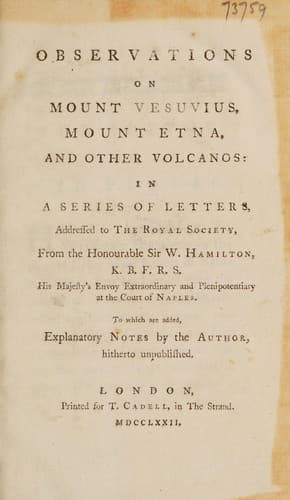
Observations on Mount Vesuvius, Mount Etna, and Other Volcanos — John Shaqi
Observations on Mount Vesuvius, Mount Etna, and Other VolcanosHamilton, William, Sir
Science
Observations on Mount Vesuvius, Mount Etna, and Other Volcanos
Hamilton, William, Sir
Etna, Mount (Italy) -- Early works to 1800; Vesuvius (Italy) -- Early works to 1800; Volcanoes -- Italy -- Early works to 1800
Father Goree's account of the formation of the new island in the
Archipelago (situated between the two islands called Kammeni, and near
that of Santorini) of which he was an eye-witness, strongly confirms the
probability of the conjectures I venture to send you, relative to the
formation of those islands and that part of the continent above
described: it seems likewise to confirm the accounts given by Strabo,
Pliny, Justin, and other ancient authors, of many islands in the
Archipelago, formerly called the Ciclades, having sprung up from the
bottom of the sea[42] in the like manner. According to Pliny, in the
4th year of the CXXXVth Olympiad, 237 years before the Christian aera,
the island of Thera (now Santorini) and Theresia were formed by
explosion; and, 130 years later, the island Hiera (now called the great
Kammeni) rose up. Strabo describes the birth of this island in these
words: "In the middle space between Thera and Theresia flames burst out
of the sea for four days, which, by degrees, throwing up great masses,
as if they had been raised by machines, they formed an island of twelve
stadia in circuit." And Justin says of the same island, "Eodem anno
inter insulas Theramenem et Theresiam, medio utriusque ripae et maris
spatio, terrae motus fuit: in quo, cum admiratione navigantium, repente
ex profundo cum calidis aquis Insula emersit."
Pliny mentions also the formation of Aspronisi, or the White Island, by
explosion, in the time of Vespasian. It is known, likewise, that in the
year 1628, one of the islands of the Azores, near the island of St.
Michael, rose up from the bottom of the sea, which was in that place 160
fathoms deep; and that this island, which was raised in fifteen days, is
three leagues long, a league and a half broad, and rises three hundred
and sixty feet above water.
Father Goree, in his account of the formation of the new island in the
Archipelago, mentions two distinct matters that entered into the
composition of this island, the one black, the other white. Aspronisi,
probably from its very name, is composed of the white matter, which if,
upon examination, it proves to be a _tufa_, as I strongly suspect, I
should think myself still more grounded in my conjectures; though I must
confess, as it is, I have scarcely a doubt left with respect to the
country I have been describing having been thrown up in a long series
of ages by various explosions from subterraneous fire. Surely there are
at present many existing Volcanos in the known world; and the memory of
many others have been handed down to us by history. May there not
therefore have been many others, of such ancient dates as to be out of
the reach of history[43]?
Public-domain text, read in full here on John Shaqi.
Reviews
Reviews
No reviews yet
Be the first to share your thoughts on this work.
Join the Discussion
Join the discussion
Sign in to leave a comment or review.
Sign InorCreate an account